

2025 Valid AZ-204 test answers & Microsoft Exam PDF
Free Microsoft AZ-204 Exam Questions and Answer from Training Expert Free4Torrent
Microsoft AZ-204 exam is a valuable credential for developers who want to expand their skills and knowledge in cloud computing. It covers a wide range of topics related to Azure development, and passing the exam can help developers to advance their careers and increase their earning potential. If you are a developer who is looking to work with Azure, then the AZ-204 exam is definitely worth considering.
Exam Pattern
During the Microsoft AZ-204 exam, the applicants will have 180 minutes to clear 40 to 60 multiple-choice questions. To complete the test within the given limit, one must start polishing time management skills beforehand. It is also important to mention that the exam is available in Simplified Chinese, English, Korean, and Japanese. The voucher will cost you $165. AZ-204 exam is scheduled via Pearson VUE.
NEW QUESTION # 82
You need to configure the Account Kind, Replication, and Storage tier options for the corporate website's Azure Storage account.
How should you complete the configuration? To answer, select the appropriate options in the dialog box in the answer area.
NOTE: Each correct selection is worth one point.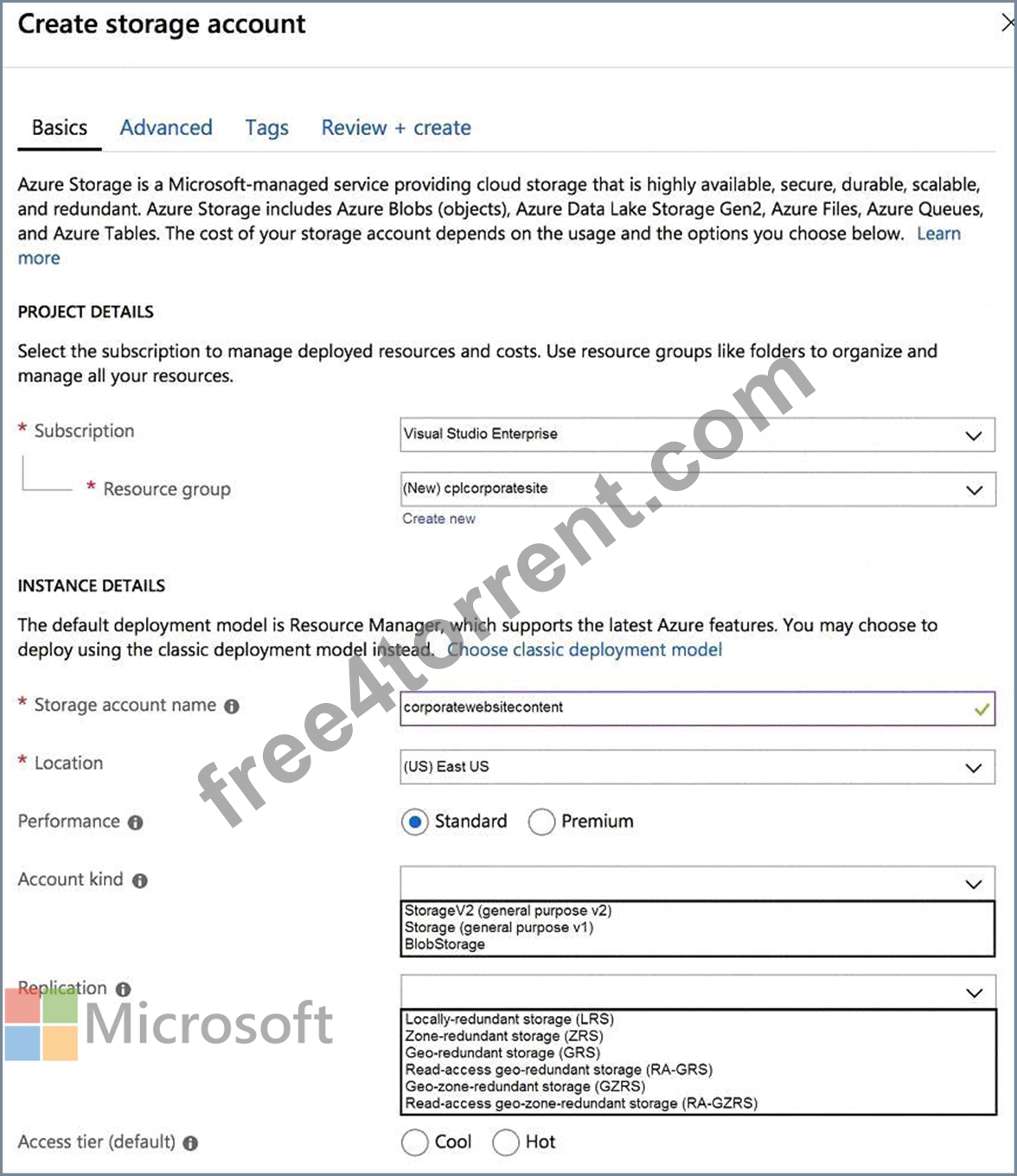
Answer:
Explanation: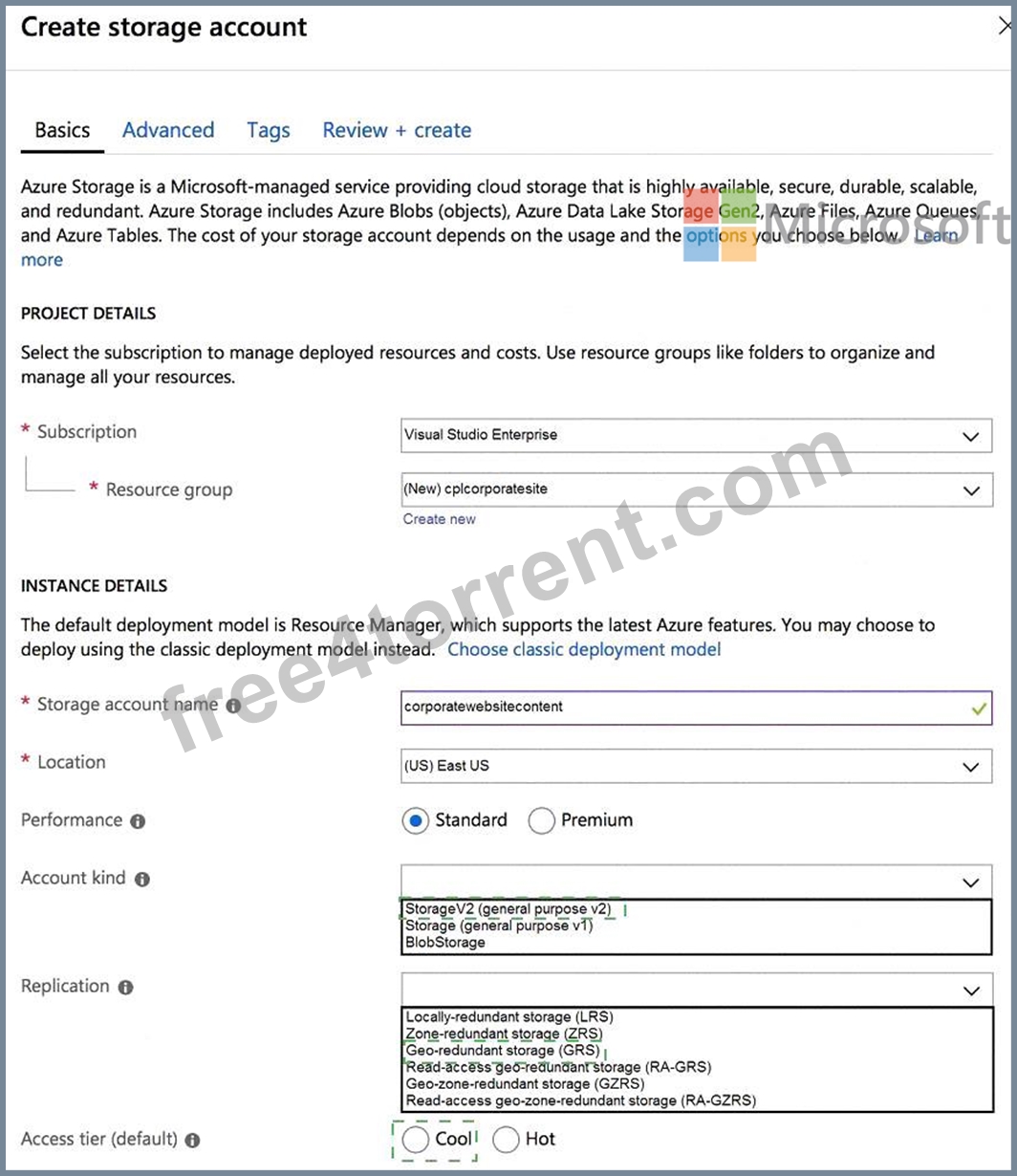
Explanation: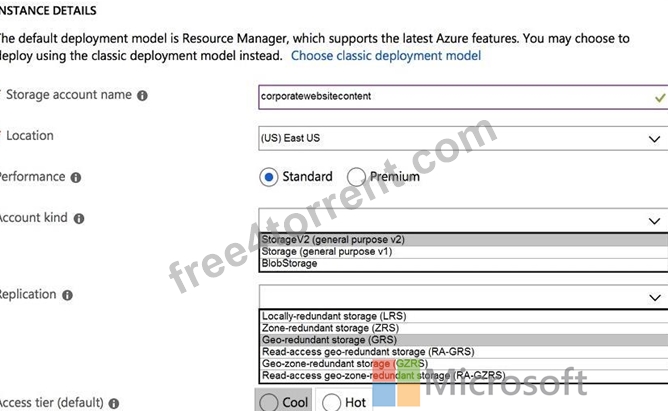
Account Kind: StorageV2 (general-purpose v2)
Scenario: Azure Storage blob will be used (refer to the exhibit). Data storage costs must be minimized.
General-purpose v2 accounts: Basic storage account type for blobs, files, queues, and tables. Recommended for most scenarios using Azure Storage.
Reference:
https://docs.microsoft.com/en-us/azure/storage/common/storage-account-overview
https://docs.microsoft.com/en-us/azure/storage/common/storage-redundancy
https://docs.microsoft.com/en-us/azure/storage/blobs/storage-blob-storage-tiers?tabs=azure-portal
Topic 4, Proseware, Inc
Case study
This is a case study. Case studies are not timed separately. You can use as much exam time as you would like to complete each case. However, there may be additional case studies and sections on this exam. You must manage your time to ensure that you are able to complete all questions included on this exam in the time provided.
To answer the questions included in a case study, you will need to reference information that is provided in the case study. Case studies might contain exhibits and other resources that provide more information about the scenario that is described in the case study. Each question is independent of the other questions in this case study.
At the end of this case study, a review screen will appear. This screen allows you to review your answers and to make changes before you move to the next section of the exam. After you begin a new section, you cannot return to this section.
To start the case study
To display the first question in this case study, click the Next button. Use the buttons in the left pane to explore the content of the case study before you answer the questions. Clicking these buttons displays information such as business requirements, existing environment, and problem statements. When you are ready to answer a question, click the Question button to return to the question.
Background
You are a developer for Proseware, Inc. You are developing an application that applies a set of governance policies for Proseware's internal services, external services, and applications. The application will also provide a shared library for common functionality.
Requirements
Policy service
You develop and deploy a stateful ASP.NET Core 2.1 web application named Policy service to an Azure App Service Web App. The application reacts to events from Azure Event Grid and performs policy actions based on those events.
The application must include the Event Grid Event ID field in all Application Insights telemetry.
Policy service must use Application Insights to automatically scale with the number of policy actions that it is performing.
Policies
Log policy
All Azure App Service Web Apps must write logs to Azure Blob storage. All log files should be saved to a container named logdrop. Logs must remain in the container for 15 days.
Authentication events
Authentication events are used to monitor users signing in and signing out. All authentication events must be processed by Policy service. Sign outs must be processed as quickly as possible.
PolicyLib
You have a shared library named PolicyLib that contains functionality common to all ASP.NET Core web services and applications. The PolicyLib library must:
* Exclude non-user actions from Application Insights telemetry.
* Provide methods that allow a web service to scale itself.
* Ensure that scaling actions do not disrupt application usage.
Other
Anomaly detection service
You have an anomaly detection service that analyzes log information for anomalies. It is implemented as an Azure Machine Learning model. The model is deployed as a web service. If an anomaly is detected, an Azure Function that emails administrators is called by using an HTTP WebHook.
Health monitoring
All web applications and services have health monitoring at the /health service endpoint.
Issues
Policy loss
When you deploy Policy service, policies may not be applied if they were in the process of being applied during the deployment.
Performance issue
When under heavy load, the anomaly detection service undergoes slowdowns and rejects connections.
Notification latency
Users report that anomaly detection emails can sometimes arrive several minutes after an anomaly is detected.
App code
EventGridController.cs
Relevant portions of the app files are shown below. Line numbers are included for reference only and include a two-character prefix that denotes the specific file to which they belong.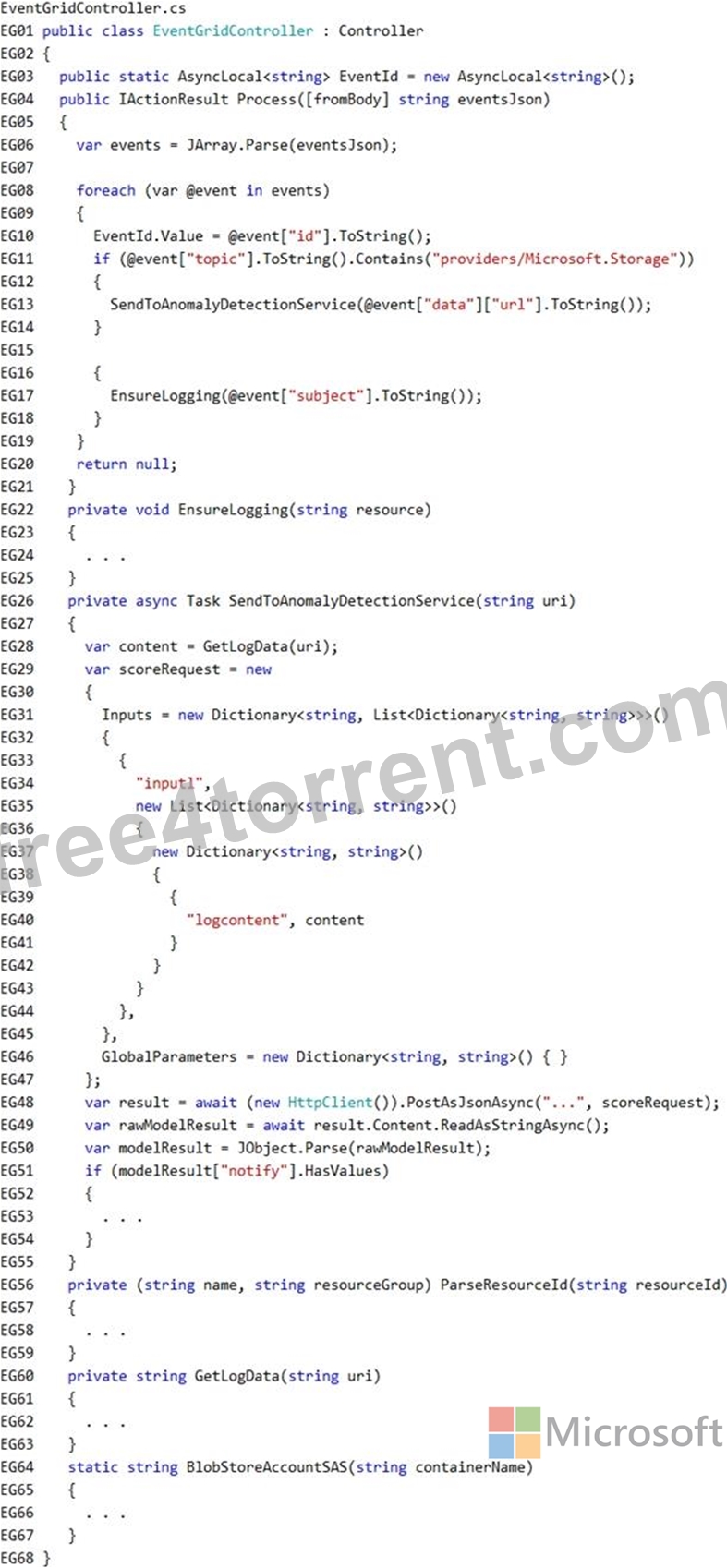
LoginEvent.cs
Relevant portions of the app files are shown below. Line numbers are included for reference only and include a two-character prefix that denotes the specific file to which they belong.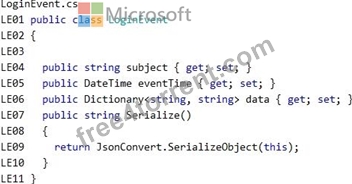
NEW QUESTION # 83
You are developing an application that uses a premium block blob storage account. You are optimizing costs by automating Azure Blob Storage access tiers.
You apply the following policy rules to the storage account. You must determine the implications of applying the rules to the data. (Line numbers are included for reference only.)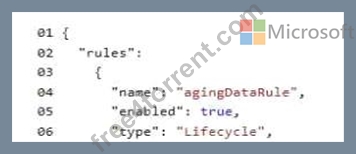
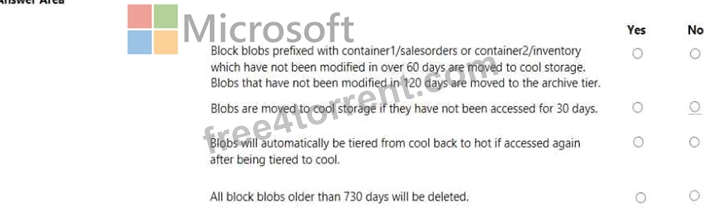
Answer:
Explanation: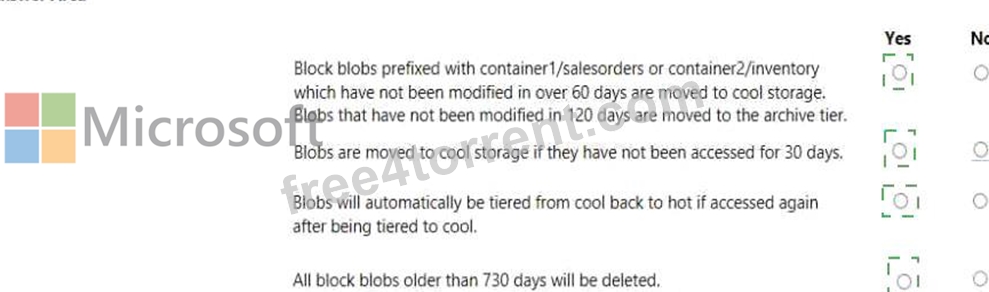
Explanation:
1. Yes
2. Yes
3. Yes
4. No
https://docs.microsoft.com/en-us/azure/storage/blobs/lifecycle-management-overview?tabs=azure- portal#move-aging-data-to-a-cooler-tier
NEW QUESTION # 84
You are developing a web application that makes calls to the Microsoft Graph API. You register the application in the Azure portal and upload a valid X509 certificate.
You create an appsettings.json file containing the certificate name, client identifier for the application, and the tenant identifier of the Azure active Directory (Azure AD). You create a method named ReadCertificate to return the X509 certificate by name.
You need to implement code that acquires a token by using the certificate.
How should you complete the code segment? To answer, select the appropriate options in the answer area.
NOTE: Each correct selection is worth one point.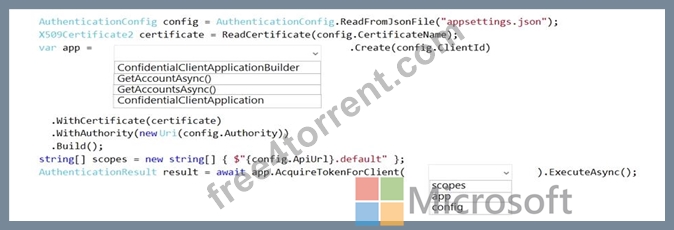
Answer:
Explanation: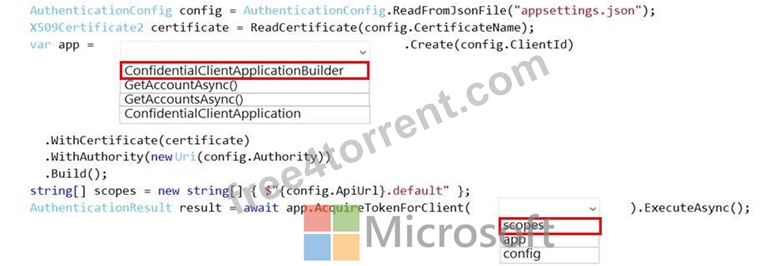
NEW QUESTION # 85
Note: This question is part of a series of questions that present the same scenario. Each question in the series contains a unique solution that might meet the stated goals. Some question sets might have more than one correct solution, while others might not have a correct solution.
After you answer a question in this section, you will NOT be able to return to it. As a result, these questions will not appear in the review screen.
You develop and deploy an Azure App Service API app to a Windows-hosted deployment slot named Development. You create additional deployment slots named Testing and Production. You enable auto swap on the Production deployment slot.
You need to ensure that scripts run and resources are available before a swap operation occurs.
Solution: Enable auto swap for the Testing slot. Deploy the app to the Testing slot.
Does the solution meet the goal?
- A. No
- B. Yes
Answer: A
Explanation:
Instead update the web.config file to include the applicationInitialization configuration element. Specify custom initialization actions to run the scripts.
Note: Some apps might require custom warm-up actions before the swap. The applicationInitialization configuration element in web.config lets you specify custom initialization actions. The swap operation waits for this custom warm-up to finish before swapping with the target slot. Here's a sample web.config fragment.
<system.webServer>
<applicationInitialization>
<add initializationPage="/" hostName="[app hostname]" />
<add initializationPage="/Home/About" hostName="[app hostname]" />
</applicationInitialization>
</system.webServer>
Reference:
https://docs.microsoft.com/en-us/azure/app-service/deploy-staging-slots#troubleshoot-swaps
NEW QUESTION # 86
You develop software solutions for a mobile delivery service. You are developing a mobile app that users can use to order from a restaurant in their area. The app uses the following workflow:
* A driver selects the restaurants from which they will deliver orders.
* Orders are sent to all available drivers in an area.
* Only orders for the selected restaurants will appear for the driver.
* The first driver to accept an order removes it from the list of available orders.
You need to implement an Azure Service Bus solution.
Which three actions should you perform in sequence? To answer, move the appropriate actions from the list of actions to the answer area and arrange them in the correct order.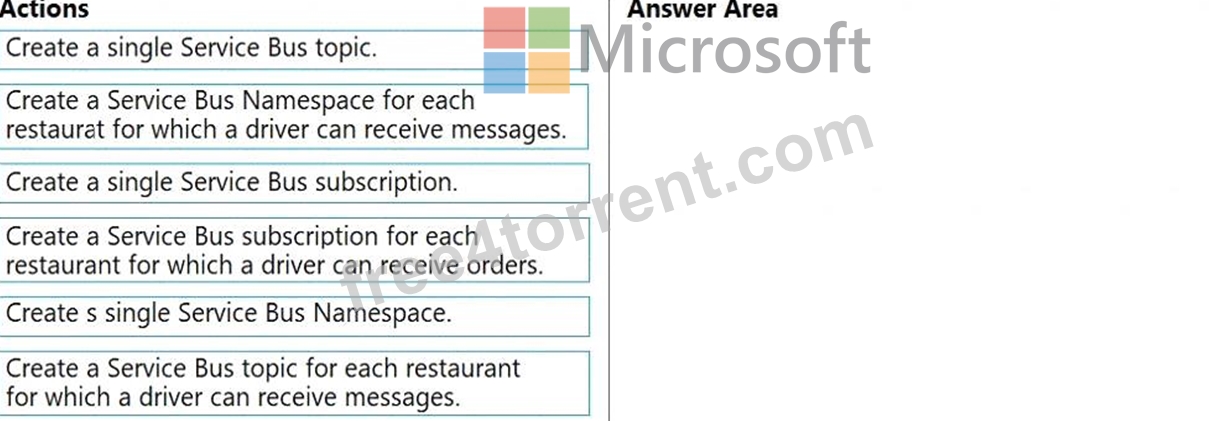
Answer:
Explanation: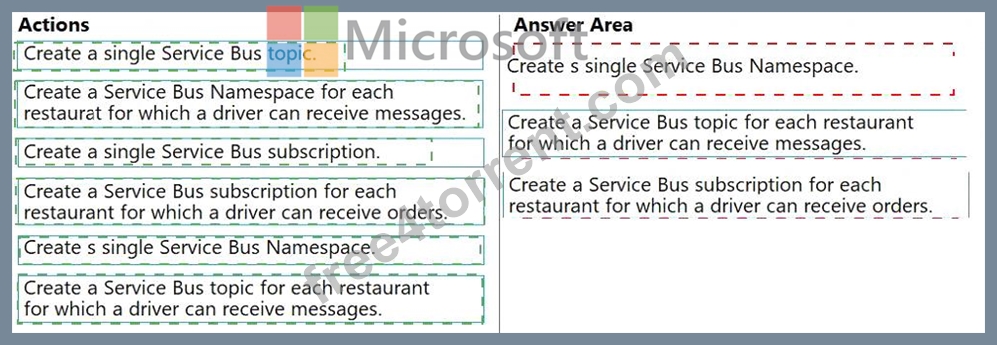
Explanation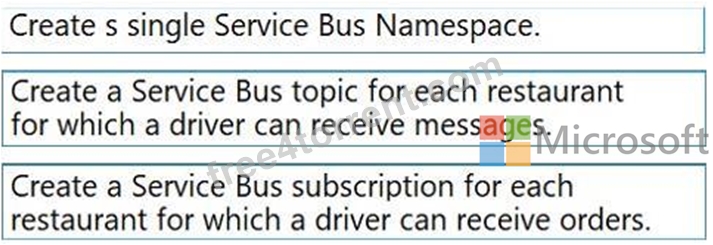
Box 1: Create a single Service Bus Namespace
To begin using Service Bus messaging entities in Azure, you must first create a namespace with a name that is unique across Azure. A namespace provides a scoping container for addressing Service Bus resources within your application.
Box 2: Create a Service Bus Topic for each restaurant for which a driver can receive messages.
Create topics.
Box 3: Create a Service Bus subscription for each restaurant for which a driver can receive orders.
Topics can have multiple, independent subscriptions.
Reference:
https://docs.microsoft.com/en-us/azure/service-bus-messaging/service-bus-messaging-overview
NEW QUESTION # 87
You develop and deploy an Azure App Service web app that connects to Azure Cache for Redis as a content cache. An resources have been deployed to East US 2 region.
The security team requires the from Azure Cache for Redis:
The number of Redis client connections from an associated IP address.
Redis operations completed on the content cache.
The location (region) in which the Azure Cache for Redis instance was accessed.
The audit information must be captured and analyzed by a security team application deployed to Central US region You need to log information on all client corrections to the cache.
Which configuration values should you use?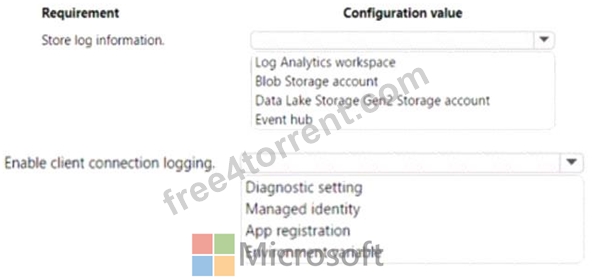
Answer:
Explanation: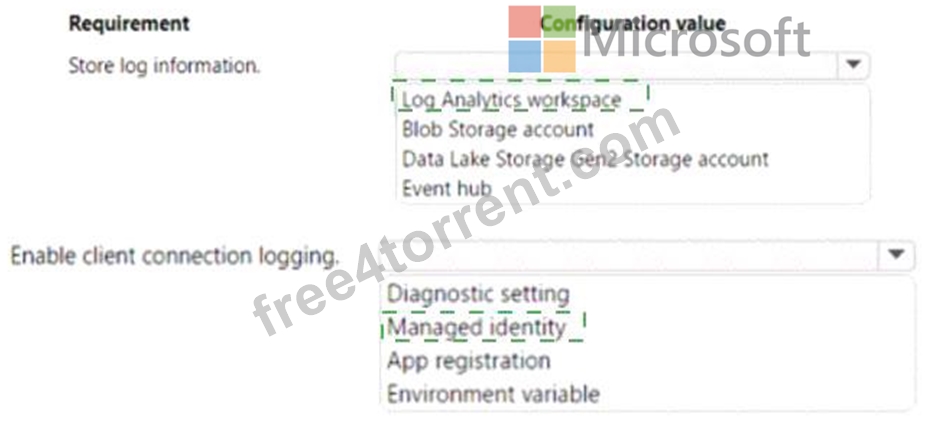
NEW QUESTION # 88
You develop and deploy an Azure App Service ---- app. The web app accesses data in an Azure SQL database You must update the web app to store frequently used data m a new Azure Cache for Redis Premium instance.
You need to implement the Azure Cache for Redis features.
Which feature should you implement? To answer, drag the appropriate feature to the correct requirements Each feature may be used once, more than once, or not at all You may need to ------------ between panes or scroll to view content.
NOTE Each correct selection is worth one point
Answer:
Explanation:
NEW QUESTION # 89
You develop and deploy a web app to Azure App Service in a production environment. You scale out the web app to four instances and configure a staging slot to support changes.
You must monitor the web app in the environment to include the following requirements:
* Increase web app availability by re-routing requests away from instances with error status codes and automatically replace instances if they remain in an error state after one hour.
* Send web server logs, application logs, standard output and standard error messaging to an Azure Storage blob account.
You need to configure Azure App Service.
Which values should you use? To answer, drag the appropriate configuration value to the correct requirements. Each configuration value may be used once, more than....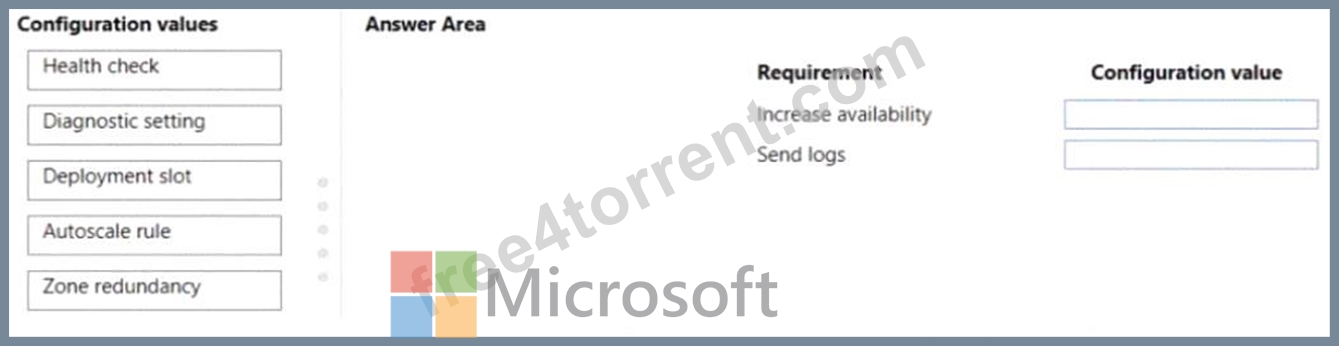
Answer:
Explanation: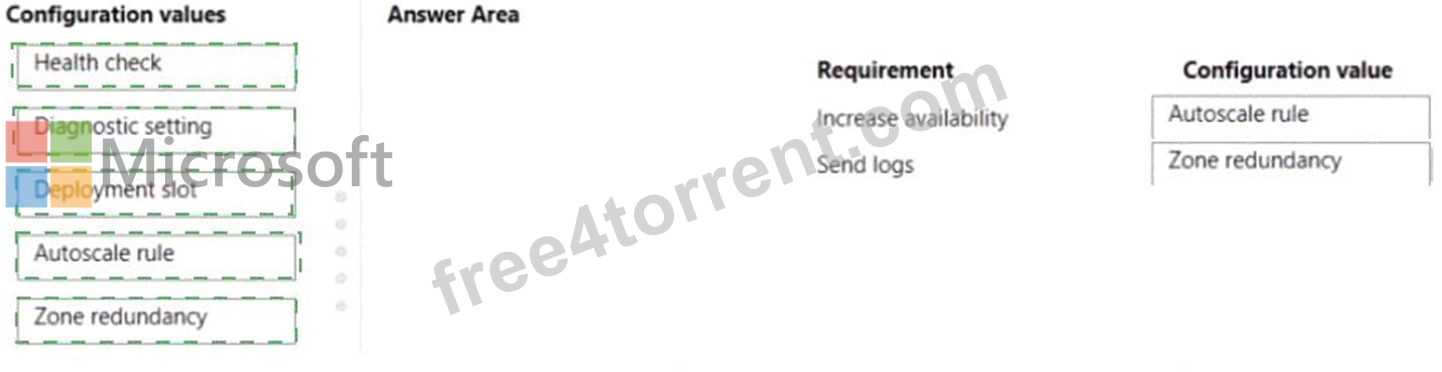
Explanation: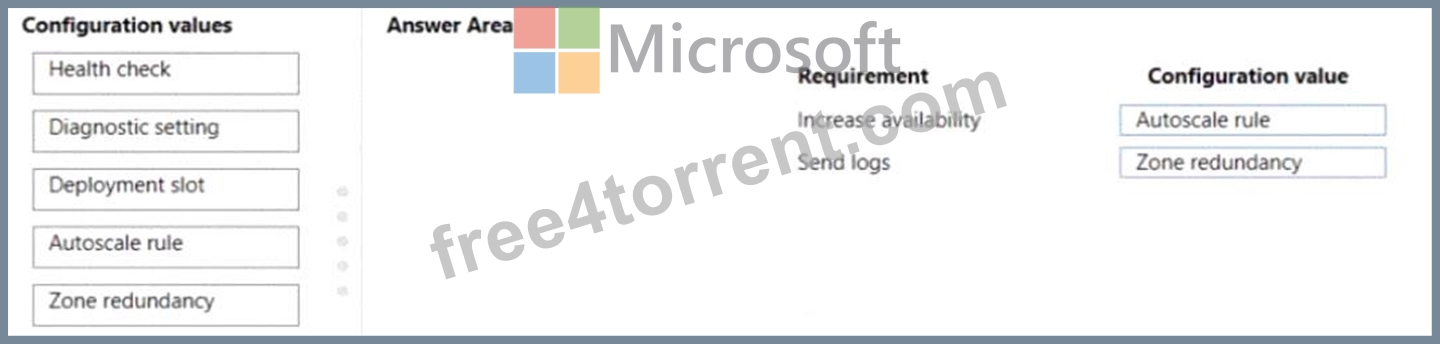
NEW QUESTION # 90
You are developing an application to use Azure Blob storage. You have configured Azure Blob storage to include change feeds.
A copy of your storage account must be created in another region. Data must be copied from the current storage account to the new storage account directly between the storage servers.
You need to create a copy of the storage account in another region and copy the data.
In which order should you perform the actions? To answer, move all actions from the list of actions to the answer area and arrange them in the correct order.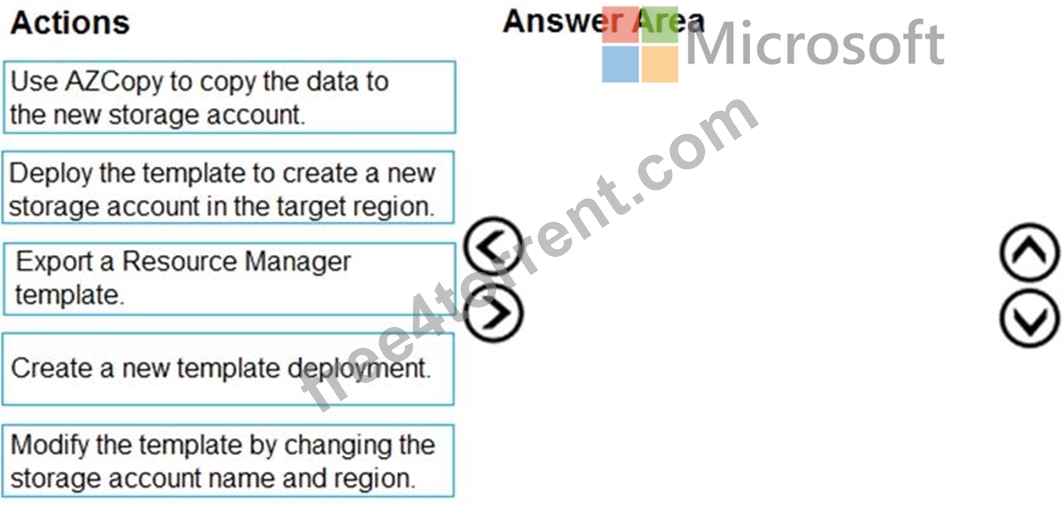
Answer:
Explanation: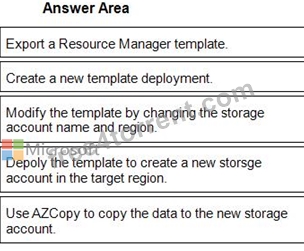
1 - Export a Resource Manager template.
2 - Create a new template deployment.
3 - Modify the template by changing the storage account name and region.
4 - Depoly the template to create a new storsge account in the target region.
5 - Use AZCopy to copy the data to the new storage account.
NEW QUESTION # 91
You are developing an Azure function that connects to an Azure SQL Database instance. The function is triggered by an Azure Storage queue.
You receive reports of numerous System.InvalidOperationExceptions with the following message:
"Timeout expired. The timeout period elapsed prior to obtaining a connection from the pool. This may have occurred because all pooled connections were in use and max pool size was reached." You need to prevent the exception.
What should you do?
- A. Convert the Azure Function to the Premium plan
- B. Convert the trigger to Azure Event Hub
- C. In the host.json file, decrease the value of the batchSize option
- D. In the function.json file, change the value of the type option to queueScaling
Answer: A
Explanation:
With the Premium plan the max outbound connections per instance is unbounded compared to the 600 active (1200 total) in a Consumption plan.
Note: The number of available connections is limited partly because a function app runs in a sandbox environment. One of the restrictions that the sandbox imposes on your code is a limit on the number of outbound connections, which is currently 600 active (1,200 total) connections per instance. When you reach this limit, the functions runtime writes the following message to the logs: Host thresholds exceeded:
Connections.
Reference:
https://docs.microsoft.com/en-us/azure/azure-functions/manage-connections
https://docs.microsoft.com/en-us/azure/azure-functions/functions-scale#service-limits Connect to and consume Azure services and third-party services Testlet 1 Case study This is a case study. Case studies are not timed separately. You can use as much exam time as you would like to complete each case. However, there may be additional case studies and sections on this exam.
You must manage your time to ensure that you are able to complete all questions included on this exam in the time provided.
To answer the questions included in a case study, you will need to reference information that is provided in the case study. Case studies might contain exhibits and other resources that provide more information about the scenario that is described in the case study. Each question is independent of the other questions in this case study.
At the end of this case study, a review screen will appear. This screen allows you to review your answers and to make changes before you move to the next section of the exam. After you begin a new section, you cannot return to this section.
To start the case study
To display the first question in this case study, click the Next button. Use the buttons in the left pane to explore the content of the case study before you answer the questions. Clicking these buttons displays information such as business requirements, existing environment, and problem statements. When you are ready to answer a question, click the Question button to return to the question.
Current environment
Windows Server 2016 virtual machine
This virtual machine (VM) runs BizTalk Server 2016. The VM runs the following workflows:
* Ocean Transport - This workflow gathers and validates container information including container contents and arrival notices at various shipping ports.
* Inland Transport - This workflow gathers and validates trucking information including fuel usage, number of stops, and routes.
The VM supports the following REST API calls:
* Container API - This API provides container information including weight, contents, and other attributes.
* Location API - This API provides location information regarding shipping ports of call and trucking stops.
* Shipping REST API - This API provides shipping information for use and display on the shipping website.
Shipping Data
The application uses MongoDB JSON document storage database for all container and transport information.
Shipping Web Site
The site displays shipping container tracking information and container contents. The site is located at http:// shipping.wideworldimporters.com/ Proposed solution The on-premises shipping application must be moved to Azure. The VM has been migrated to a new Standard_D16s_v3 Azure VM by using Azure Site Recovery and must remain running in Azure to complete the BizTalk component migrations. You create a Standard_D16s_v3 Azure VM to host BizTalk Server. The Azure architecture diagram for the proposed solution is shown below: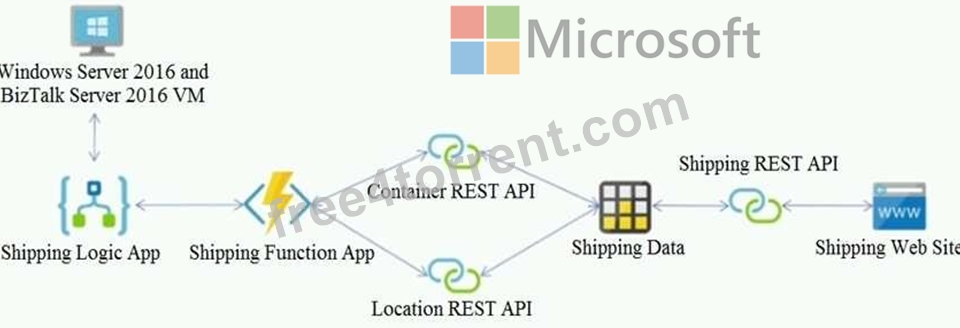
Requirements
Shipping Logic app
The Shipping Logic app must meet the following requirements:
* Support the ocean transport and inland transport workflows by using a Logic App.
* Support industry-standard protocol X12 message format for various messages including vessel content details and arrival notices.
* Secure resources to the corporate VNet and use dedicated storage resources with a fixed costing model.
* Maintain on-premises connectivity to support legacy applications and final BizTalk migrations.
Shipping Function app
Implement secure function endpoints by using app-level security and include Azure Active Directory (Azure AD).
REST APIs
The REST API's that support the solution must meet the following requirements:
* Secure resources to the corporate VNet.
* Allow deployment to a testing location within Azure while not incurring additional costs.
* Automatically scale to double capacity during peak shipping times while not causing application downtime.
* Minimize costs when selecting an Azure payment model.
Shipping data
Data migration from on-premises to Azure must minimize costs and downtime.
Shipping website
Use Azure Content Delivery Network (CDN) and ensure maximum performance for dynamic content while minimizing latency and costs.
Issues
Windows Server 2016 VM
The VM shows high network latency, jitter, and high CPU utilization. The VM is critical and has not been backed up in the past. The VM must enable a quick restore from a 7-day snapshot to include in-place restore of disks in case of failure.
Shipping website and REST APIs
The following error message displays while you are testing the website:
Failed to load http://test-shippingapi.wideworldimporters.com/: No 'Access- Control-Allow-Origin' header is present on the requested resource. Origin
'http://test.wideworldimporters.com/' is therefore not allowed access.
NEW QUESTION # 92
ASP.NET Core API app by using C#. The API app will allow users to authenticate by using Twitter and Azure Active Directory (Azure AD).
Users must be authenticated before calling API methods. You must log the user's name for each method call.
You need to configure the API method calls.
Which values should you use? To answer, select the appropriate options in the answer area.
NOTE: Each correct selection is worth one point.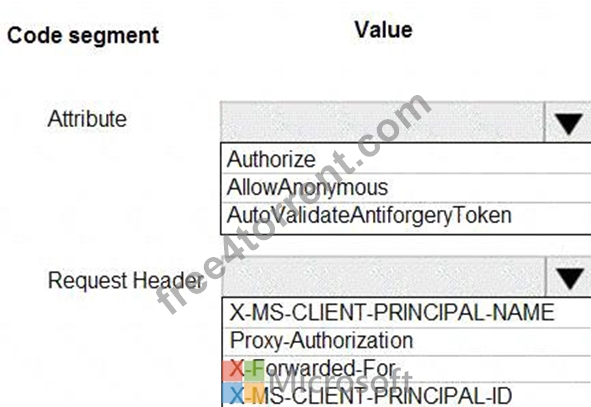
Answer:
Explanation: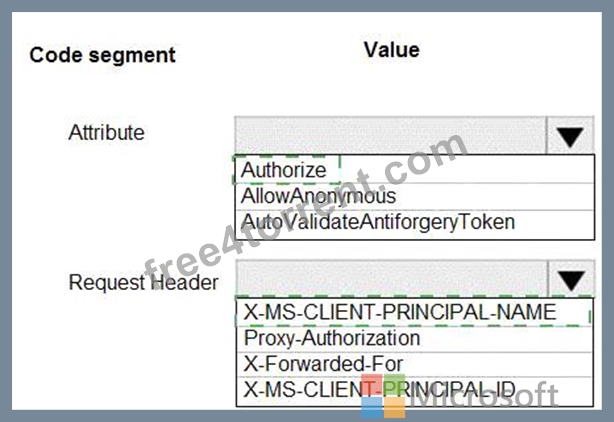
Explanation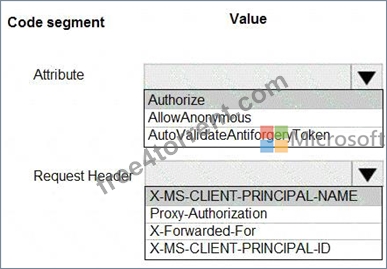
+ Explanation:
Box 1: Authorize
Box 2: X-MS-CLIENT-PRINCIPAL-NAME
App Service passes user claims to your application by using special headers. External requests aren't allowed to set these headers, so they are present only if set by App Service. Some example headers include:
X-MS-CLIENT-PRINCIPAL-NAME
X-MS-CLIENT-PRINCIPAL-ID
Here's the set of headers you get from Easy Auth for a Twitter authenticated user:
{
"cookie": "AppServiceAuthSession=Lx43...xHDTA==",
"x-ms-client-principal-name": "evilSnobu",
"x-ms-client-principal-id": "35....",
"x-ms-client-principal-idp": "twitter",
"x-ms-token-twitter-access-token": "35...Dj",
"x-ms-token-twitter-access-token-secret": "OK3...Jx",
}
References:
https://docs.microsoft.com/en-us/azure/app-service/app-service-authentication-how-to
NEW QUESTION # 93
You are building a website to access project data related to terms within your organization. The website does not allow anonymous access. Authentication performed using an Azure Active Directory (Azure AD) app named internal.
The website has the following authentication requirements:
*Azure AD users must be able to login to the website.
*Personalization of the website must be based on membership in Active Directory groups.
You need to configure the application's manifest to meet the authentication requirements.
How should you configure the manifest? To answer, select the appropriate options in the answer area.
NOTE: Each correct selection is worth one point.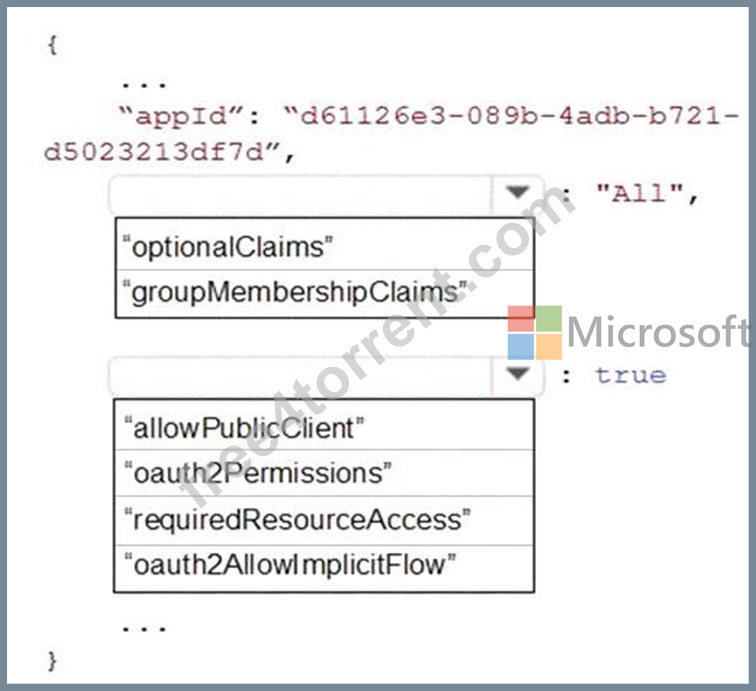
Answer:
Explanation: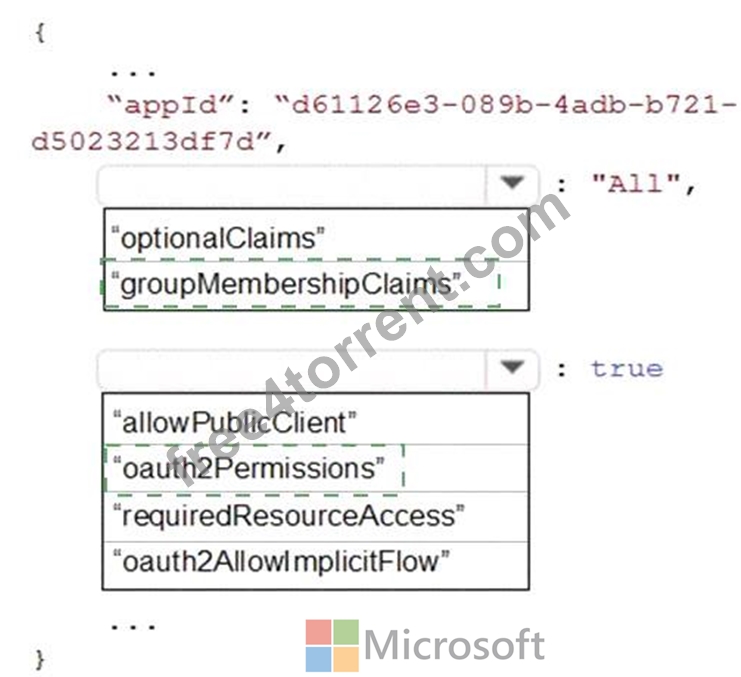
Explanation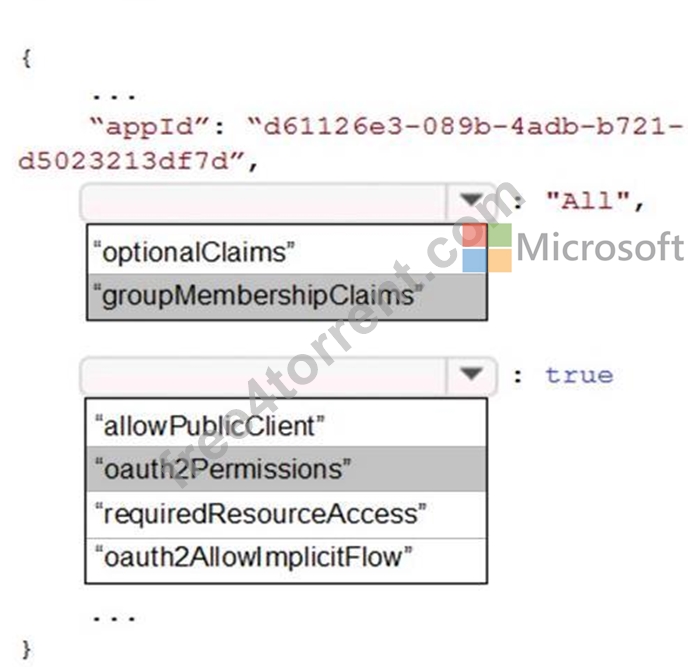
Box 1: groupMembershipClaims
Scenario: Personalization of the website must be based on membership in Active Directory groups.
Group claims can also be configured in the Optional Claims section of the Application Manifest.
Enable group membership claims by changing the groupMembershipClaim
The valid values are:
"All"
"SecurityGroup"
"DistributionList"
"DirectoryRole"
Box 2: oauth2Permissions
Scenario: Azure AD users must be able to login to the website.
oauth2Permissions specifies the collection of OAuth 2.0 permission scopes that the web API (resource) app exposes to client apps. These permission scopes may be granted to client apps during consent.
NEW QUESTION # 94
ASP.NET Core API app by using C#. The API app will allow users to authenticate by using Twitter and Azure Active Directory (Azure AD).
Users must be authenticated before calling API methods. You must log the user's name for each method call.
You need to configure the API method calls.
Which values should you use? To answer, select the appropriate options in the answer area.
NOTE: Each correct selection is worth one point.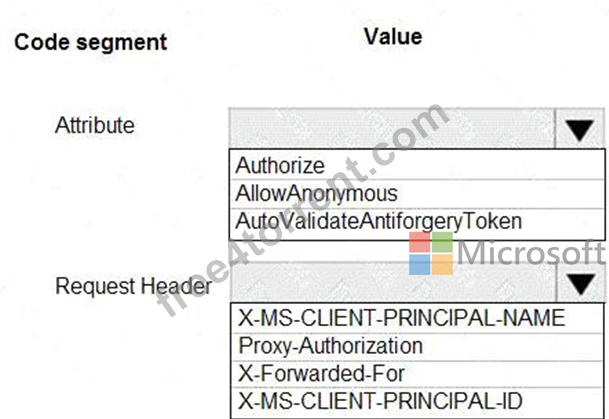
Answer:
Explanation: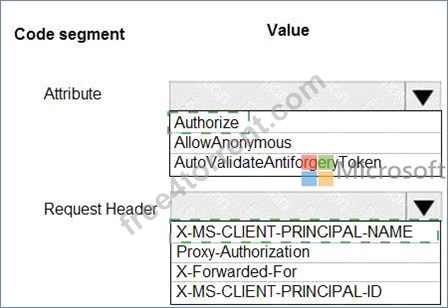
Explanation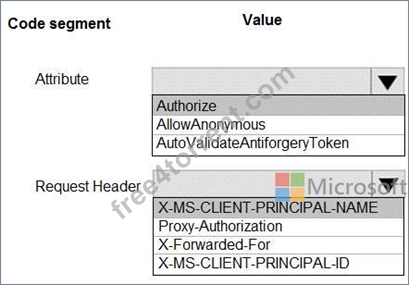
+ Explanation:
Box 1: Authorize
Box 2: X-MS-CLIENT-PRINCIPAL-NAME
App Service passes user claims to your application by using special headers. External requests aren't allowed to set these headers, so they are present only if set by App Service. Some example headers include:
X-MS-CLIENT-PRINCIPAL-NAME
X-MS-CLIENT-PRINCIPAL-ID
Here's the set of headers you get from Easy Auth for a Twitter authenticated user:
{
"cookie": "AppServiceAuthSession=Lx43...xHDTA==",
"x-ms-client-principal-name": "evilSnobu",
"x-ms-client-principal-id": "35....",
"x-ms-client-principal-idp": "twitter",
"x-ms-token-twitter-access-token": "35...Dj",
"x-ms-token-twitter-access-token-secret": "OK3...Jx",
}
References:
https://docs.microsoft.com/en-us/azure/app-service/app-service-authentication-how-to
NEW QUESTION # 95
You are developing an Azure Function app.
The Azure Function app must enable a WebHook to read an image from Azure Blob Storage and create a new Azure Cosmos DB document.
You need to implement the Azure Function app.
Which configuration should you use? To answer, select the appropriate options in the answer area.
NOTE: Each correct selection is worth one point.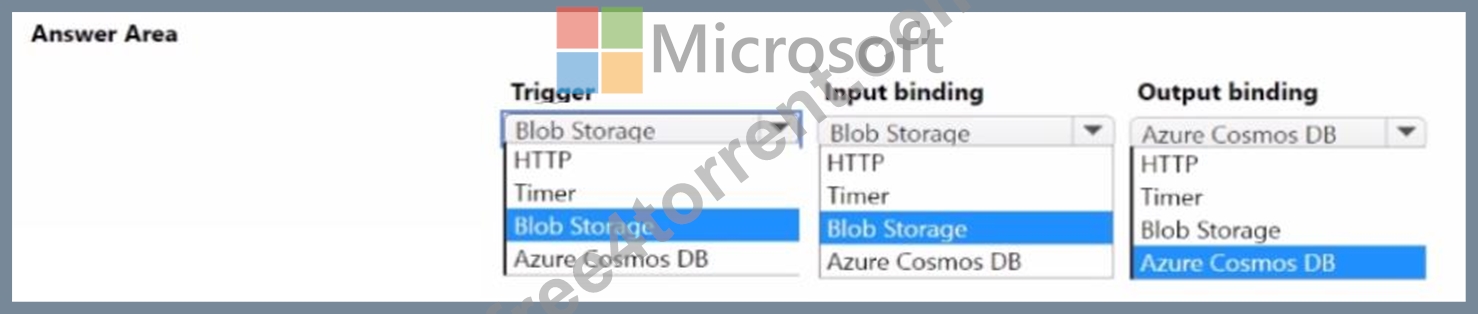
Answer:
Explanation: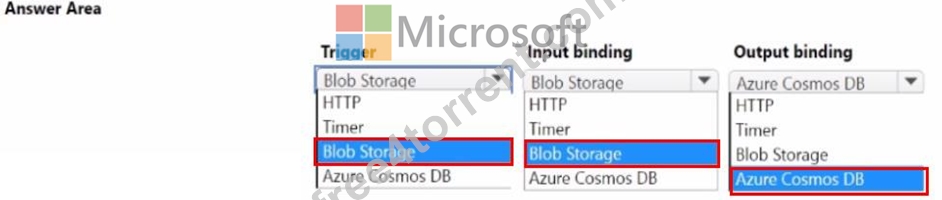
NEW QUESTION # 96
You are developing a solution for a hospital to support the following use cases:
* The most recent patient status details must be retrieved even if multiple users in different locations have updated the patient record.
* Patient health monitoring data retrieved must be the current version or the prior version.
* After a patient is discharged and all charges have been assessed, the patient billing record contains the final charges.
You provision a Cosmos DB NoSQL database and set the default consistency level for the database account to Strong. You set the value for Indexing Mode to Consistent.
You need to minimize latency and any impact to the availability of the solution. You must override the default consistency level at the query level to meet the required consistency guarantees for the scenarios.
Which consistency levels should you implement? To answer, drag the appropriate consistency levels to the correct requirements. Each consistency level may be used once, more than once, or not at all. You may need to drag the split bar between panes or scroll to view content.
NOTE: Each correct selection is worth one point.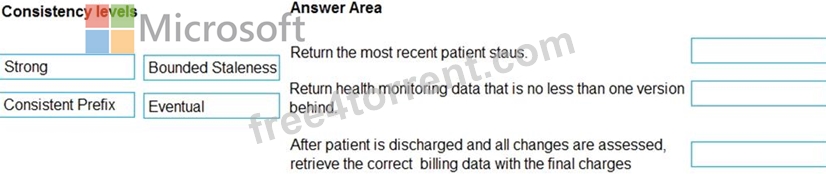
Answer:
Explanation: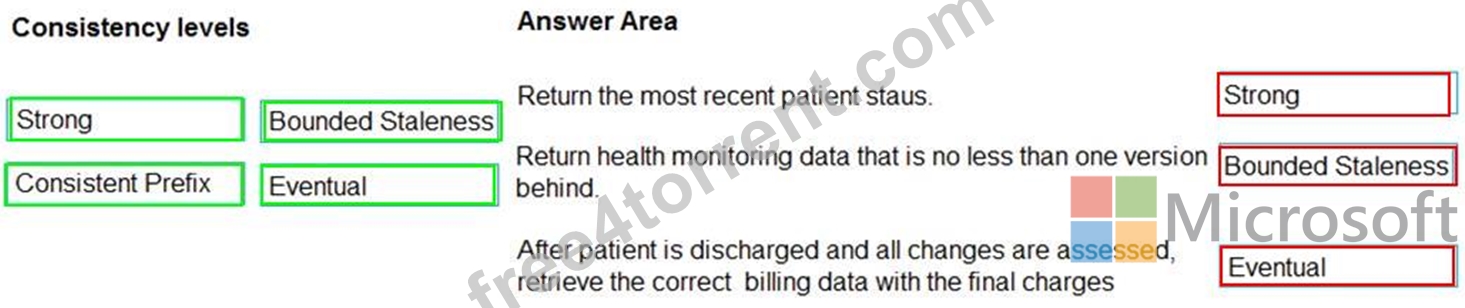
Reference:
https://docs.microsoft.com/en-us/azure/cosmos-db/consistency-levels
NEW QUESTION # 97
......
Microsoft AZ-204 exam is a challenging exam that tests the candidate's knowledge and experience in developing solutions for Microsoft Azure. Successful completion of AZ-204 exam will validate the candidate's skills in building cloud solutions using the Azure platform and demonstrate their expertise to potential employers.
Top Microsoft AZ-204 Courses Online: https://pdfdumps.free4torrent.com/AZ-204-valid-dumps-torrent.html