

Real SAP C-THR83-2505 Exam Questions [Updated 2026]
C-THR83-2505 Exam Dumps Pass with Updated 2026 SAP Certified Associate - Implementation Consultant - SAP SuccessFactors Recruiting: Recruiter Experience
NEW QUESTION # 25
Where are background elements mapped to synchronize the data between People Profile and the Candidate Profile?
- A. In the Job Requisition template
- B. In the Candidate Profile template
- C. In the Succession Data Model
- D. In the Application template
Answer: B
Explanation:
Background elements, which allow for the capture of information such as previous employment or education, are mapped within the Candidate Profile template. This mapping supports synchronization between the People Profile and Candidate Profile.
Steps to Configure:
In the Candidate Profile template, define the mapping for background elements that should sync with the People Profile.
This mapping will ensure that relevant candidate information flows between the profiles seamlessly.
Reference:
Explanation of Incorrect Options:
Option A - Job Requisition Template: The requisition template does not handle candidate profile background mappings.
Option B - Succession Data Model: The Succession Data Model is unrelated to Candidate Profile background element mapping.
Option D - Application Template: Background elements are mapped specifically in the Candidate Profile template, not the Application template.
NEW QUESTION # 26
Where are background elements mapped to synchronize the data between People Profile and the Candidate Profile?
- A. In the Job Requisition template
- B. In the Candidate Profile template
- C. In the Succession Data Model
- D. In the Application template
Answer: B
Explanation:
Background elements, which allow for the capture of information such as previous employment or education, are mapped within the Candidate Profile template. This mapping supports synchronization between the People Profile and Candidate Profile.
* Steps to Configure:
* In the Candidate Profile template, define the mapping for background elements that should sync with the People Profile.
* This mapping will ensure that relevant candidate information flows between the profiles seamlessly.
: SAP SuccessFactors Recruiting Management and Employee Central Integration Guide - Synchronizing Background Elements.
Explanation of Incorrect Options:
Option A - Job Requisition Template: The requisition template does not handle candidate profile background mappings.
Option B - Succession Data Model: The Succession Data Model is unrelated to Candidate Profile background element mapping.
Option D - Application Template: Background elements are mapped specifically in the Candidate Profile template, not the Application template.
NEW QUESTION # 27
What happens if you set the candidate application attribute sensitive to "true"?
- A. The field content is covered by ***
- B. The field is considered for purging of personally identifying data.
- C. The field is hidden unless an override is set.
- D. "Access or change this field" will be captured in the Read Audit Log.
Answer: B
Explanation:
Setting the candidate application attribute sensitive to "true" marks the field for consideration in data purging routines. This is part of data privacy features where personal data is purged according to data retention and privacy policies.
* Functionality and Effects:
* When a field is marked sensitive, it is included in data purging processes to remove PII from the system after certain retention periods.
* This aligns with data protection regulations by ensuring PII is only retained as necessary.
: SAP SuccessFactors Recruiting Management Data Privacy Guide - Sensitive Data Handling and Data Purge.
Explanation of Incorrect Options:
Option A - "Access or change this field" will be captured in the Read Audit Log: This is more relevant to audit configuration than to data sensitivity settings.
**Option C - The field content is covered by ***: Masking the content is separate from marking data as sensitive.
Option D - The field is hidden unless an override is set: Marking a field as sensitive does not automatically hide it; it flags it for data purging.
NEW QUESTION # 28
What is the effect of activating the Profile Before Application feature?
- A. A candidate needs to complete their profile before being able to search for a position.
- B. The registration via LinkedIn on career sites is now available.
- C. A candidate needs to complete their profile before being able to send an application.
- D. A candidate's application can be admitted late to the selection process.
Answer: C
Explanation:
When the Profile Before Application feature is activated in SAP SuccessFactors Recruiting, candidates are required to complete their profile information before submitting a job application. This feature ensures that key candidate details are collected upfront, providing recruiters with a more complete candidate profile from the outset.
Candidate Profile Completion Requirement:
Candidates are prompted to fill out their profile details, such as work experience, education, and personal information, prior to applying for a position. This step must be completed before the application process can continue.
Benefits of Profile Before Application:
Ensures standardized candidate data for all applications.
Saves time by reducing repetitive data entry for candidates applying for multiple positions.
Reference:
Explanation of Incorrect Options:
Option A: Profile completion is required before sending an application, not before searching.
Option C: LinkedIn registration is unrelated to this feature.
Option D: Profile Before Application does not influence the timing of application admission.
NEW QUESTION # 29
Which actions are available from Manage Jobs after a job is posted with Recruiting Posting? Note: There are
2 correct answers to this question.
- A. Remove a contract with a posting job board.
- B. Remove the posting from all posting job boards.
- C. Post the job to additional job boards.
- D. Repost the job automatically after the expiration date.
Answer: B,C
Explanation:
Once a job is posted using Recruiting Posting, administrators have several actions available in the Manage Jobs section to further manage the job posting.
* Remove the Posting from All Job Boards (Option A):
* This action allows users to remove the job posting from all job boards where it was posted through Recruiting Posting. This feature is useful if a position needs to be closed or withdrawn before the posting expires.
* Post the Job to Additional Job Boards (Option B):
* After the initial posting, users can choose to post the job to additional job boards directly from the Manage Jobs interface, broadening the reach of the job posting as needed.
: SAP SuccessFactors Recruiting Posting Implementation Guide - Actions Available After Job Posting.
Explanation of Incorrect Options:
Option C (Remove a contract) and Option D (Repost automatically) are not available actions within Manage Jobs after a job is posted. Contracts are managed separately, and reposting after expiration typically requires manual configuration.
NEW QUESTION # 30
What are some SAP recommended guiding principles to achieve clean core operations? Note: There are 3 correct answers to this question.
- A. Establish regular housekeeping tasks and procedures.
- B. Establish an organizational structure technical foundation and transformation methodology for clean core.
- C. Define roles and responsibilities as part of a process transformation office.
- D. Establish release management.
- E. Integrate clean core practices in the end-to-end value process chain.
Answer: A,D,E
Explanation:
SAP recommends several guiding principles to maintain a clean core in SAP environments, minimizing customizations that can complicate future upgrades and maintenance:
Establish Regular Housekeeping Tasks (Option A):
Routine housekeeping ensures the system is free of obsolete data and configurations, improving performance and simplifying management.
Establish Release Management (Option B):
An organized release management strategy is crucial to streamline updates, maintain clean configurations, and prevent conflicting customizations.
Integrate Clean Core Practices in the End-to-End Value Process Chain (Option D):
Embedding clean core principles across all business processes helps maintain consistency, standardize operations, and ensure the long-term maintainability of the system.
Reference:
Explanation of Incorrect Options:
Option C - Define roles and responsibilities: While important, this is not a specific guiding principle for a clean core.
Option E - Establish organizational structure for clean core: This focuses more on team structure than on core system practices.
NEW QUESTION # 31
When building the sm-mapping between People Profile and Candidate Profile to which data model does the second field-id reference?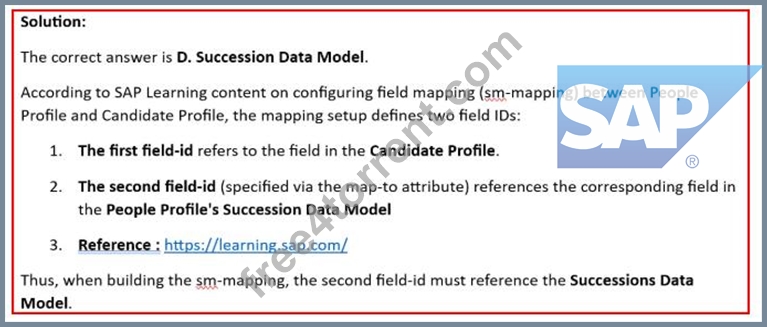
- A. Succession Data Model
- B. Job Requisition template
- C. Candidate Data Model
- D. Candidate Profile template
Answer: A
Explanation:
When setting up sm-mapping between the People Profile and the Candidate Profile, the second field-id in the mapping references the Succession Data Model. The Succession Data Model defines the fields used in the People Profile, and sm-mapping is used to align these fields with those in the Candidate Profile.
sm-mapping Configuration:
In the configuration, the first field-id refers to the Candidate Profile template, while the second field-id links to the corresponding field in the Succession Data Model for the People Profile.
Purpose of sm-mapping:
This mapping allows data synchronization between the Candidate Profile and People Profile, ensuring consistent data across the system.
NEW QUESTION # 32
What field-permission do you configure on the Candidate Profile template?
- A. Read and write permissions for candidates and dynamic groups
- B. Read and write for candidates only
- C. None read and write for candidates and dynamic groups
- D. None read and write for dynamic groups only
Answer: A
Explanation:
On the Candidate Profile template, you configure read and write permissions to control access for both candidates and dynamic groups. This allows granular control over which sections of the profile are editable or visible to specific users or groups.
* Steps to Configure:
* Go to the Candidate Profile template XML configuration.
* Define the appropriate read and write permissions for fields based on roles or dynamic groups.
: SAP SuccessFactors Recruiting Management Data Model Guide - Configuring Permissions in the Candidate Profile Template.
Explanation of Incorrect Options:
Option B - None read and write for candidates and dynamic groups: The absence of read and write permissions would limit visibility and editing functions.
Option C - None read and write for dynamic groups only: Permissions can be set selectively, but both candidates and dynamic groups commonly have permissions set.
Option D - Read and write for candidates only: Permissions are typically defined for both candidates and groups, not candidates only.
NEW QUESTION # 33
Which step is required to connect an Application template to the Job Requisition template?
- A. Configure a new Application template with a new << template-name>.
- B. Map the <application-status-set > in the Job Requisition template.
- C. Map the application template name in the Job Requisition template.
- D. Connect the templates in Form Template Settings.
Answer: C
Explanation:
To connect an Application template to a Job Requisition template, you must map the name of the application template in the Job Requisition template. This configuration ensures that the requisition is correctly associated with the application template, allowing applicants to complete the correct application form.
Define the Application Template Name in the Job Requisition XML:
Open the Job Requisition XML template and locate the section where the application template name is referenced.
Use the application-template-name field to link the correct application template.
Save and Deploy the Configuration:
Ensure the updated XML file is correctly uploaded to the system to activate the connection.
NEW QUESTION # 34
What action is possible within Interview Central?
- A. The interviewer can extend the Offer Letter.
- B. Candidates can be rated based on a set of competencies.
- C. The recruiter can invite the candidate to apply.
- D. Candidates can be moved to another status.
Answer: B
Explanation:
In Interview Central, interviewers have the ability to rate candidates based on a predefined set of competencies. This feature allows for structured assessment and consistent evaluation criteria across interviewers.
Steps to Use:
Within Interview Central, select the candidate and rate them on each of the competencies provided.
Ratings can be viewed and used to compare candidates across different competency areas.
Reference:
Explanation of Incorrect Options:
Option A - Move Candidates to Another Status: Status changes are typically done in the main candidate management view.
Option B - Extend Offer Letter: Offer letters are managed separately in the offer management process, not in Interview Central.
Option D - Invite Candidate to Apply: This is done outside of Interview Central.
NEW QUESTION # 35
Which of the following are components of the Candidate Profile Template? Note: There are 3 correct answers to this question.
- A. Field definitions
- B. Field attribute overrides
- C. sm-mapping configuration
- D. Background elements
- E. Button permissions
Answer: B,C,D
NEW QUESTION # 36
Which of the following are characteristics of standard e-mail notification templates? Note: There are 2 correct answers to this question.
- A. Some templates are predefined for Recruiting.
- B. Some templates are shared with other modules.
- C. All standard templates are enabled by default.
- D. Standard templates can be deleted in Provisioning.
Answer: A,B
Explanation:
Standard email templates in SAP SuccessFactors have the following characteristics:
* Shared with Other Modules (Option B):Some email templates are designed for use across multiple SAP SuccessFactors modules, such as Onboarding or Employee Central, and can be shared to streamline communication workflows.
: SAP SuccessFactors Email Templates Guide - Shared and Multi-Module Templates.
Predefined for Recruiting (Option C):SAP SuccessFactors provides a set of predefined templates tailored specifically for recruiting. These templates support common recruiting actions, such as interview scheduling and application submission acknowledgments.
Reference: SAP SuccessFactors Recruiting Management Implementation Guide - Standard Email Templates.
Explanation of Incorrect Options:
Option A - Standard templates can be deleted in Provisioning: Standard templates cannot typically be deleted. They can be deactivated but remain in the system.
Option D - All standard templates are enabled by default: Not all templates are enabled by default; administrators must selectively enable and configure templates as needed.
NEW QUESTION # 37
How do you define permissions for job requisition fields? Note: There are 3 correct answers to this question.
- A. Define the permissions in the Role-Based Permissions section in the Admin Center.
- B. Set the permissions to write or read for each field.
- C. Assign a permission to a field for each status (pre-approved approved and closed).
- D. Permission the J role for each field.
- E. Add the operators for each permission block.
Answer: B,C,E
Explanation:
In SAP SuccessFactors Recruiting, defining permissions for job requisition fields involves several key steps to ensure that the right users have the necessary read or write access for each field:
Assign Permission for Each Status (Option A):
Different statuses in the requisition lifecycle (pre-approved, approved, and closed) may require distinct permissions for fields.
Add Operators for Each Permission Block (Option B):
Define operators (e.g., recruiter, hiring manager) for each permission block, determining who can view or edit fields.
Set Write or Read Permissions (Option D):
Specify the level of access-either read or write-for each field based on the roles and statuses.
Reference:
Explanation of Incorrect Options:
Option C - Permission the J role: Permissions are assigned by field and operator, not a single role.
Option E - Role-Based Permissions in Admin Center: Job requisition field permissions are typically configured within the Job Requisition Data Model XML, not directly in Role-Based Permissions.
NEW QUESTION # 38
You want to trigger e-mails by candidate status. Where is the trigger configured?
- A. In Edit Applicant Status Configuration
- B. In Manage Recruiting E-mail Templates
- C. In Recruiting E-mail Triggers
- D. In E-mail Notification Template Settings
Answer: A
Explanation:
To trigger emails by candidate status, the appropriate configuration is done in the Edit Applicant Status Configuration section. Here, administrators can define email notifications based on specific candidate status changes.
Steps to Configure:
Go to Admin Center > Edit Applicant Status Configuration.
Select the relevant status and specify the email template to trigger for each status change.
Save the configuration to ensure that emails are triggered automatically based on status changes.
Reference:
Explanation of Incorrect Options:
Option B - In E-mail Notification Template Settings: This is for managing general email templates, not configuring status-based triggers.
Option C - In Recruiting E-mail Triggers: This option does not exist as a specific configuration area.
Option D - In Manage Recruiting E-mail Templates: This is used to manage email templates but does not control the triggering mechanism for candidate status changes
NEW QUESTION # 39
You have enabled Interview Scheduling.
Where can a candidate manage all of their activities related to an interview?
- A. In the Agency Portal
- B. In the Career Portal
- C. In the Candidates tab
- D. In Interview Central
Answer: B
Explanation:
When Interview Scheduling is enabled in SAP SuccessFactors, candidates can manage all their interview-related activities through the Career Portal. This includes reviewing interview invitations, confirming interview times, and viewing any related information about the interview process.
Career Portal Access for Candidates:
The Career Portal serves as the primary interface where candidates can view and manage their scheduled interviews and related actions.
Reference:
Explanation of Incorrect Options:
B (Agency Portal): Used by agencies to submit candidates but not for candidates to manage their own interview schedules.
C (Candidates tab) and D (Interview Central) are tools used by recruiters and interviewers, not for candidate self-service.
NEW QUESTION # 40
How do you define permissions for job requisition fields? Note: There are 3 correct answers to this question.
- A. Define the permissions in the Role-Based Permissions section in the Admin Center.
- B. Set the permissions to write or read for each field.
- C. Assign a permission to a field for each status (pre-approved approved and closed).
- D. Permission the J role for each field.
- E. Add the operators for each permission block.
Answer: B,C,E
Explanation:
In SAP SuccessFactors Recruiting, defining permissions for job requisition fields involves several key steps to ensure that the right users have the necessary read or write access for each field:
* Assign Permission for Each Status (Option A):Different statuses in the requisition lifecycle (pre- approved, approved, and closed) may require distinct permissions for fields.
* Add Operators for Each Permission Block (Option B):Define operators (e.g., recruiter, hiring manager) for each permission block, determining who can view or edit fields.
* Set Write or Read Permissions (Option D):Specify the level of access-either read or write-for each field based on the roles and statuses.
: SAP SuccessFactors Recruiting Management Data Model Guide - Field Permissions and Role Configurations.
Explanation of Incorrect Options:
Option C - Permission the J role: Permissions are assigned by field and operator, not a single role.
Option E - Role-Based Permissions in Admin Center: Job requisition field permissions are typically configured within the Job Requisition Data Model XML, not directly in Role-Based Permissions.
NEW QUESTION # 41
When creating multi-stage application permission blocks which of the following must be defined in the permission? Note: There are 2 correct answers to this question.
- A. Permission type (read or write)
- B. Operator
- C. Status label
- D. Applicant type
Answer: A,B
Explanation:
In multi-stage application settings, each permission block must define certain elements to control access for different stages of the application process:
Operator (Option A):
The operator refers to users involved in the recruiting process, such as hiring managers, recruiters, and approvers. Each permission block must define the operator to specify who has access to the application stage.
Steps:
Go to Admin Center > Manage Recruiting Roles.
Configure each operator's access to the relevant stage.
Reference:
Permission Type (read or write) (Option C):
Each permission block must also specify the type of access-either read or write-allowing you to control who can view or edit application information at a given stage.
Steps:
In the Application Template XML, define the read/write access for each stage and operator.
Explanation of Incorrect Options:
Option B: Applicant type does not need to be specified in each permission block; permissions are applied based on stages and roles.
Option D: Status labels are not required in permission blocks; they are typically used for candidate status tracking.
NEW QUESTION # 42
......
C-THR83-2505 Exam Dumps, C-THR83-2505 Practice Test Questions: https://pdfdumps.free4torrent.com/C-THR83-2505-valid-dumps-torrent.html