

Get 2023 Free Microsoft AZ-800 Exam Practice Materials Collection
Get Latest and 100% Accurate AZ-800 Exam Questions
Microsoft AZ-800 exam is an essential certification for IT professionals who are responsible for managing hybrid infrastructures. By passing AZ-800 exam, candidates can demonstrate their expertise in this domain and increase their value to potential employers. With the demand for hybrid infrastructure professionals on the rise, the Microsoft AZ-800 certification can help IT professionals stand out and advance their careers.
NEW QUESTION # 94
Your network contains an Active Directory Domain Services (AD DS) domain named adatum.com The domain contains a server named Server1 and the users shown In the following table.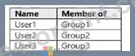
Server1 contains a folder named D:\Folder1. The advanced security settings for Folder 1 are configured as shown in the Permissions exhibit. (Click the Permissions lab.)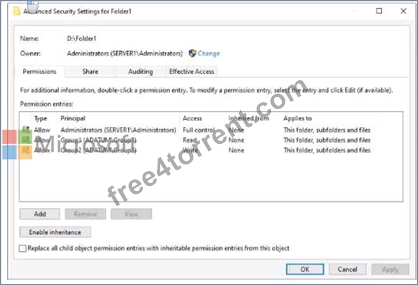
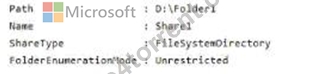
Folder1 is shared by using the following configurations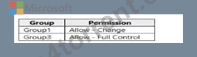

Answer:
Explanation:
NEW QUESTION # 95
You deploy a single-domain Active Directory Domain Services (AD DS) forest named contoso.com.
You deploy a server to the domain and configure the server to run a service.
You need to ensure that the service can use a group managed service account (gMSA) to authenticate.
Which three PowerShell cmdlets should you run in sequence? To answer, move the appropriate cmdlets from the list of cmdlets to the answer area and arrange them in the correct order.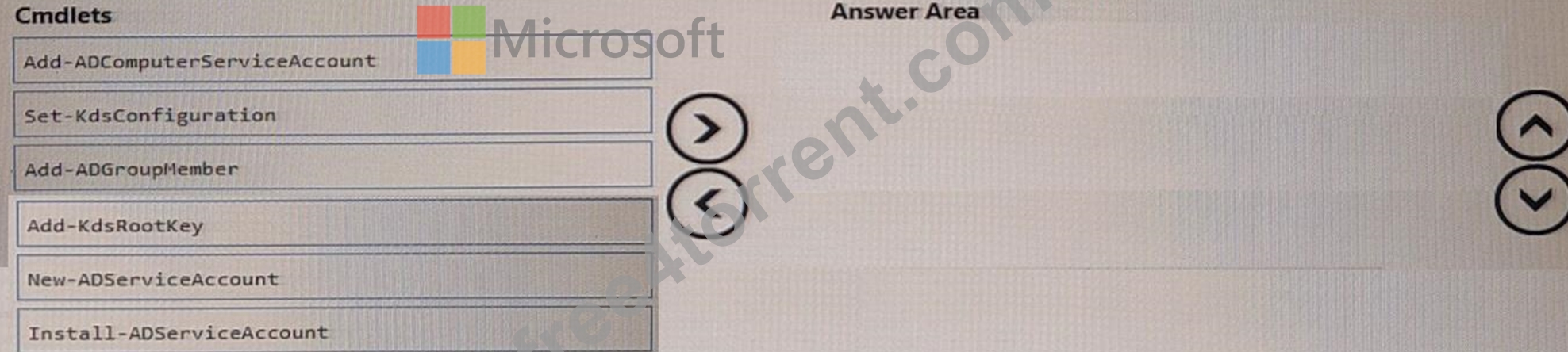
Answer:
Explanation: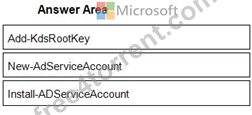
1 - Add-KdsRootKey
2 - New-AdServiceAccount
3 - Install-ADServiceAccount
NEW QUESTION # 96
You have a server named Server1 that runs Windows Server.
You plan to host applications in Windows containers.
You need to configure Server1 to run containers. What should you install?
- A. Windows Admin Center
- B. the Windows Subsystem for Linux
- C. Hyper-V
- D. Doctor
Answer: D
NEW QUESTION # 97
Your network contains an Active Directory Domain Services (AD DS) forest named contoso.com. The forest contains a child domain named east.contoso.com and the servers shown in the following table.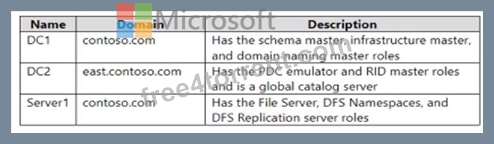
You need to create a folder for the Central Store to manage Group Policy template files for the entire forest.
What should you name the folder, and on which server should you create the folder? To answer, select the appropriate options in the answer area.
NOTE: Each correct selection is worth one point.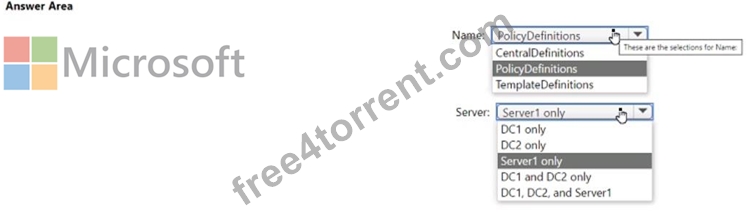
Answer:
Explanation: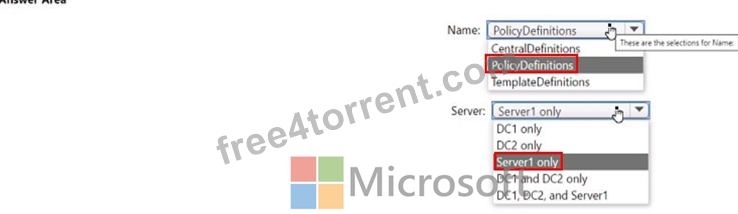
NEW QUESTION # 98
You have a server named Server1 that runs Windows Server and contains two drives named C and D. Server1 hosts multiple file shares.
You enable Data Deduplication on drive D and select the General purpose file server workload.
You need to minimize the space consumed by files that were recently modified or deleted.
What should you do?
- A. Run the Set-DedupSchedule Cmdlet and configure a GarbageCollection job.
- B. Run the set-dedupvolume cmdlet and configure the scrubbing job.
- C. Run the Set-DedupSchedule cmdlet and configure the optimization job.
- D. Run the set-Dedupvoiume cmdlet and configure the InputOutputScale settings.
Answer: A
Explanation:
Topic 2, Contoso Ltd
Overview
This is a case study. Case studies are not timed separately. You can use as much exam time as you would like to complete each case. However, there may be additional case studies and sections on this exam. You must manage your time to ensure that you are able to complete all questions included on this exam in the time provided.
To answer the questions included in a case study, you will need to reference information that is provided in the case study. Case studies might contain exhibits and other resources that provide more Information about the scenario that is described in the case study. Each question is independent of the other questions in this case study.
At the end of this case study, a review screen will appear. This screen allows you to review your answers and to make changes before you move to the next section of the exam. After you begin a new section, you cannot return to this section.
To start the case study
To display the first question in this case study, click the Next button. Use the buttons in the left pane to explore the content of the case study before you answer the questions. Clicking these buttons displays information such as business requirements, existing environment, and problem statements, if the case study has an All Information tab. note that the information displayed is identical to the information displayed on the subsequent tabs. When you are ready to answer a question, click the Question button to return to the question.
AD DS Environment
The network contains an on-premises Active Directory Domain Services (AD DS) forest named contoso.com. The forest contains two domains named contoso.com and canada.contoso.com. The forest contains the domain controllers shown in the following table.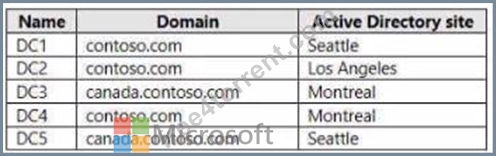
All the domain controllers are global catalog servers.
Server Infrastructure
The network contains the servers shown in the following table.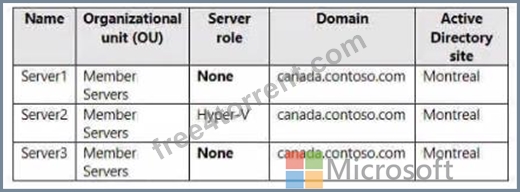
A server named Server4 runs Windows Server and is in a workgroup. Windows Firewall on Servei4 uses the private profile.
Server2 hosts three virtual machines named VM1. VM2, and VM3.
VM3 is a file server that stores data in the volumes shown in the following table.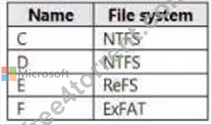
Group Policies
The contoso.com domain has the Group Policies Objects (GPOs) shown in the following table.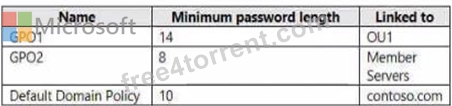
Existing Identities
The forest contains the users shown in the following table.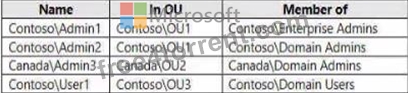
The forest contains the groups shown in the following table.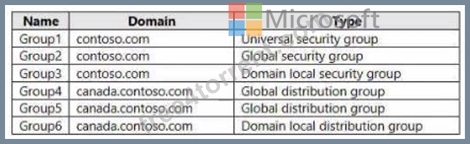
Current Problems
When an administrator signs in to the console of VM2 by using Virtual Machine Connection, and then disconnects from the session without signing out another administrator can connect to the console session as the currently signed-in user.
Requirements
Contoso identifies the following technical requirements:
* Change the replication schedule for all site links to 30 minutes.
* Promote Server1 to a domain controller in canada.contoso.com.
* Install and authorize Server3 as a DHCP server.
* Ensure that User! can manage the membership of all the groups in Contoso\OU3.
* Ensure that you can manage Server4 from Server1 by using PowerShell removing.
* Ensure that you can run virtual machines on VM1.
* Force users to provide credentials when they connect to VM2.
* On VM3, ensure that Data Deduplication on all volumes is possible.
NEW QUESTION # 99
You have an Azure virtual machine named VM1 that runs Windows Server.
You need to configure the management of VM1 to meet the following requirements:
Require administrators to request access to VM1 before establishing a Remote Desktop connection.
Limit access to VM1 from specific source IP addresses.
Limit access to VM1 to a specific management port.
What should you configure?
- A. a network security group (NSG)
- B. Azure Active Directory (Azure AD) Privileged Identity Management (PIM)
- C. Azure Front Door
- D. Microsoft Defender for Cloud
Answer: D
Explanation:
https://docs.microsoft.com/en-us/azure/defender-fo
NEW QUESTION # 100
You have an Azure Active Directory Domain Services (Azure AD DS) domain.
You create a new user named Admin1.
You need Admin1 to deploy custom Group Policy settings to all the computers in the domain. The solution must use the principle of least privilege.
What should you include in the solution? To answer, select the appropriate options in the answer area.
NOTE: Each correct selection is worth one point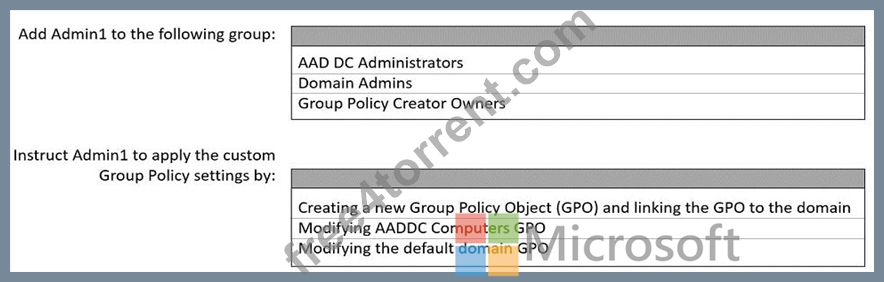
Answer:
Explanation: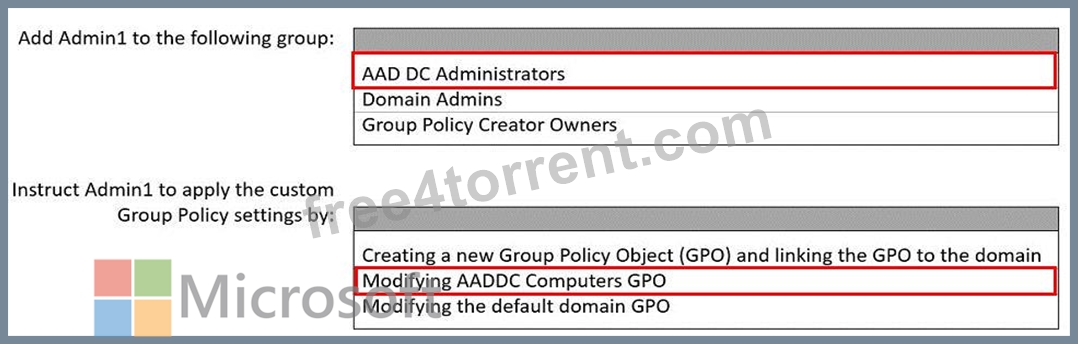
Reference:
https://docs.microsoft.com/en-us/azure/active-directory-domain-services/manage-group-policy
NEW QUESTION # 101
You have a file server named Server1 that runs Windows Server and contains the volumes shown in the following table.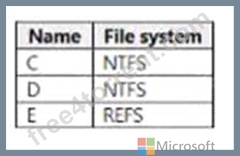
On which volumes can you use BitLocker Drive Encryption (BitLocker) and disk quotas? To answer select the appropriate options in the answer area. NOTE Each correct selection is worth one point.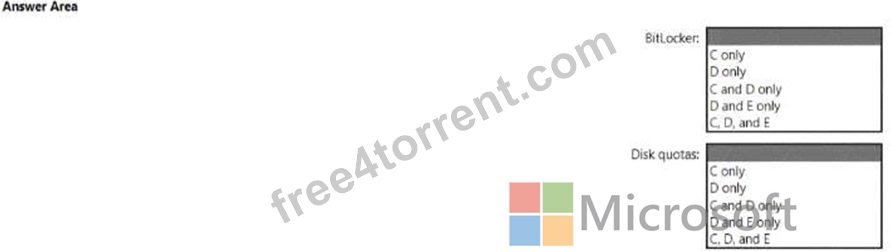
Answer:
Explanation: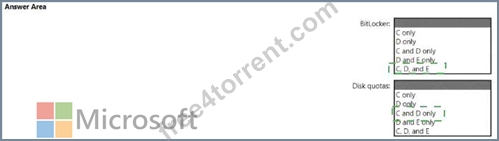
Explanation
Table Description automatically generated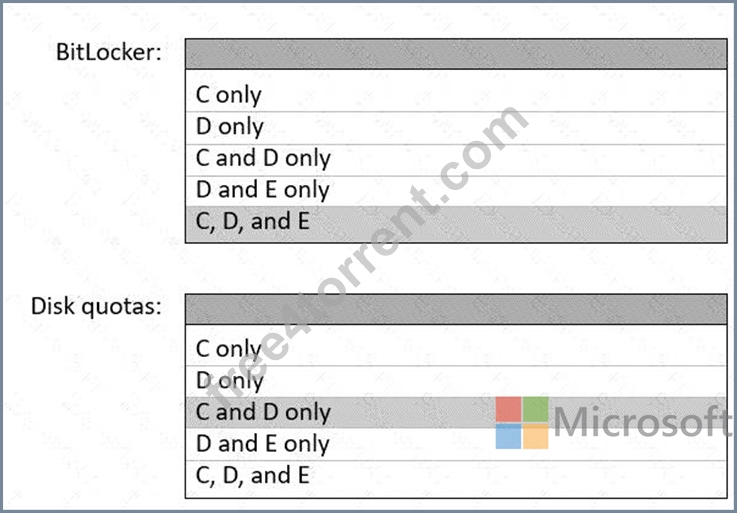
Reference:
https://docs.microsoft.com/en-us/windows-server/storage/refs/refs-overview
NEW QUESTION # 102
Your network contains an Active Directory Domain Services (AD DS) forest named contoso.com. The forest contains a child domain named east.contoso.com and the servers shown in the following table.
You need to create a folder for the Central Store to manage Group Policy template files for the entire forest.
What should you name the folder, and on which server should you create the folder? To answer, select the appropriate options in the answer area.
NOTE: Each correct selection is worth one point.
Answer:
Explanation: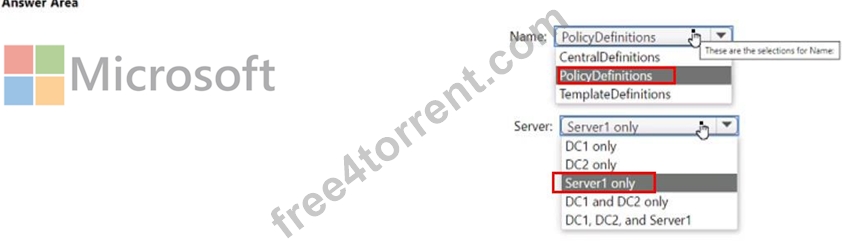
NEW QUESTION # 103
Note: This question is part of a series of questions that present the same scenario. Each question in the series contains a unique solution that might meet the stated goals. Some question sets might have more than one correct solution, while others might not have a correct solution.
After you answer a question in this section, you will NOT be able to return to it. As a result, these questions will not appear in the review screen.
You are planning the deployment of DNS to a new network.
You have three internal DNS servers as shown in the following table.
The contoso.local zone contains zone delegations for east.conloso.local and west.contoso.local. All the DNS servers use root hints.
You need to ensure that all the DNS servers can resolve the names of all the internal namespaces and internet hosts.
Solution: On Server2 and Server3, you configure a conditional forwarder for contoso.local.
Does this meet the goal?
- A. No
- B. Yes
Answer: A
NEW QUESTION # 104
You need to configure network communication between the Seattle and New York offices. The solution must meet the networking requirements.
What should you configure? To answer, select the appropriate options in the answer area.
NOTE: Each correct selection is worth one point.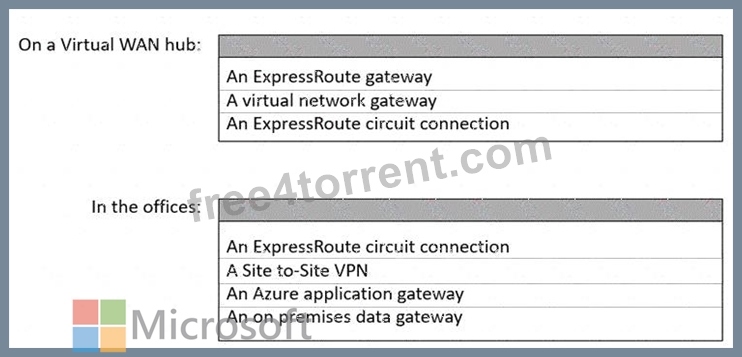
Answer:
Explanation: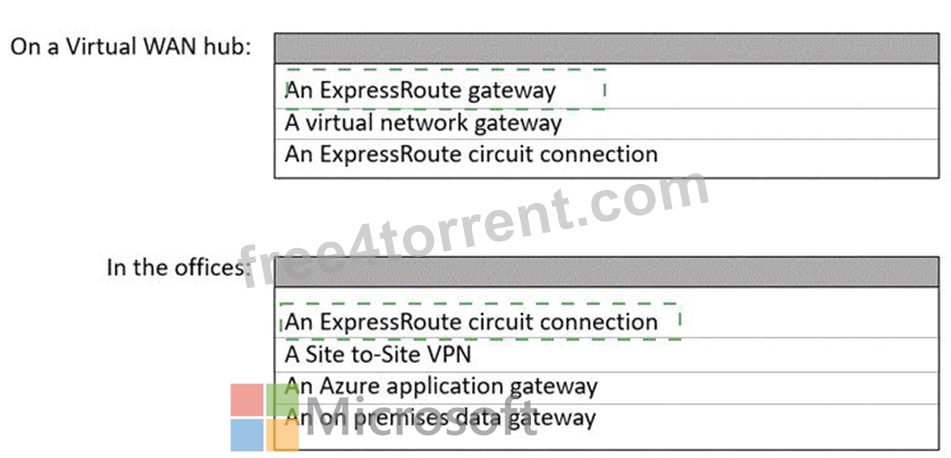
Explanation
Table Description automatically generated with medium confidence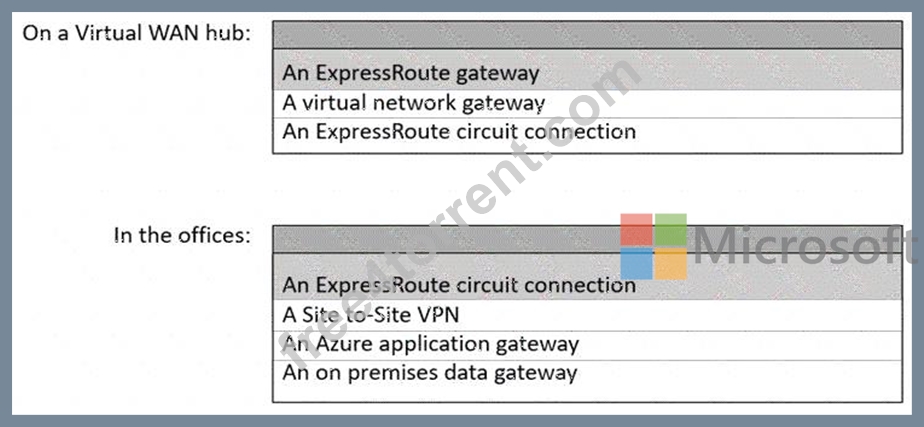
Reference:
https://docs.microsoft.com/en-us/azure/virtual-wan/virtual-wan-expressroute-portal
NEW QUESTION # 105
You have an Azure subscription that contains a virtual network named VNet1. Vnet1 contains three subnets named Subnet1, Subnet2, and Subnet3. You deploy a virtual machine that has the following settings:
* Name:VM1
* Subnet: Subnet2
* Network interface name: NIC1
* Operating system: Windows Server 2022
You need to ensure that VM1 can route traffic between Subnet1 and Subnet3. The solution must minimize administrative effort.
What should you do? To answer, select the appropriate options in the answer area.
NOTE: Each correct selection is worth one point.
Answer:
Explanation: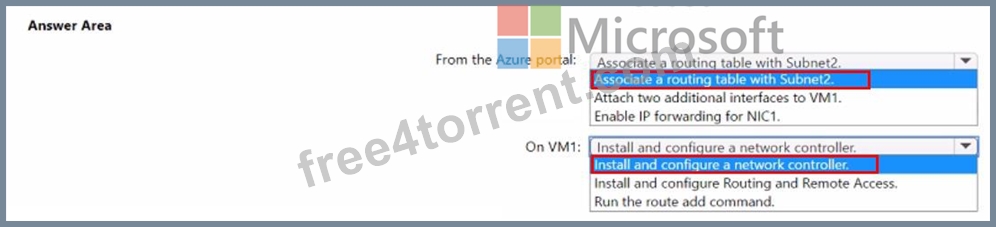
NEW QUESTION # 106
One of your friends is confused about which type of disks he should use for production and performance-sensitive workloads. He approaches you for help. What will you suggest to him?
- A. Premium SSD
- B. Standard SSD
- C. Ultra Disk
- D. Standard HDD
Answer: A
NEW QUESTION # 107
Your network contains an Active Directory Domain Services (AD DS) domain named adatum.com. The domain contains a file server named Server1 and three users named User1, User2, and User3.
Server1 contains a shared folder named Share1 that has the following configurations: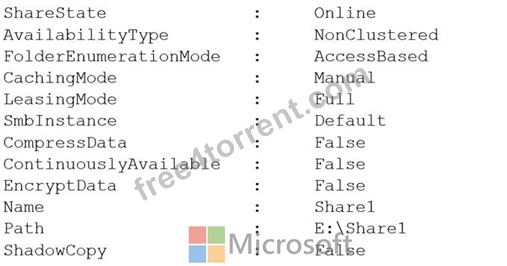
The share permissions for Share1 are configured as shown in the Share Permissions exhibit.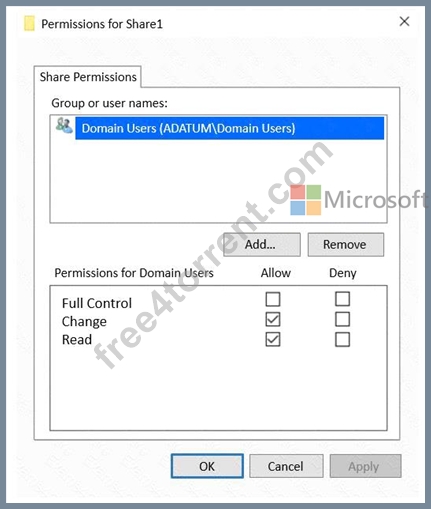
Share1 contains a file named File1.bxt. The advanced security settings for File1.txt are configured as shown in the File Permissions exhibit.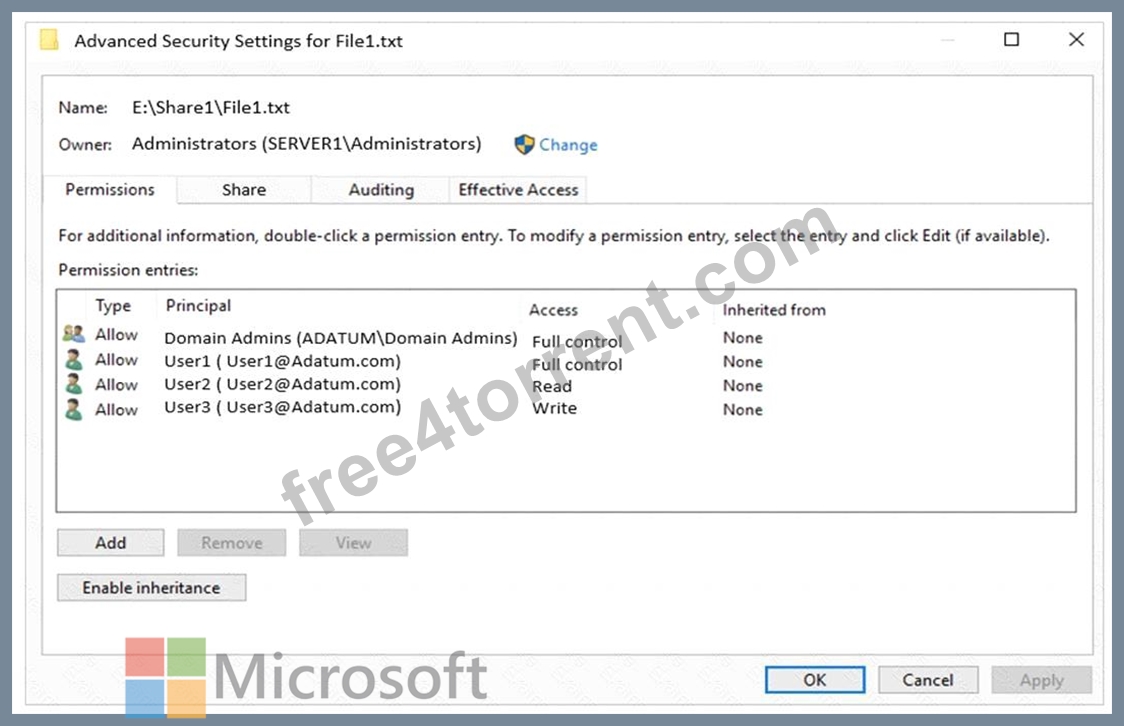
For each of the following statements, select Yes if the statement is true. Otherwise, select No.
NOTE: Each correct selection is worth one point.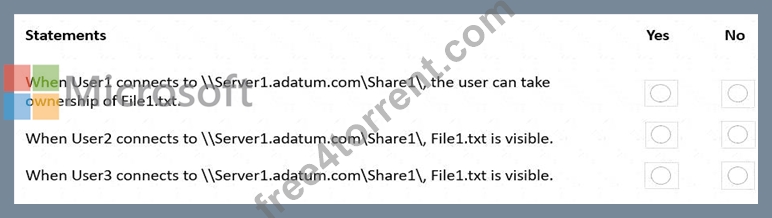
Answer:
Explanation: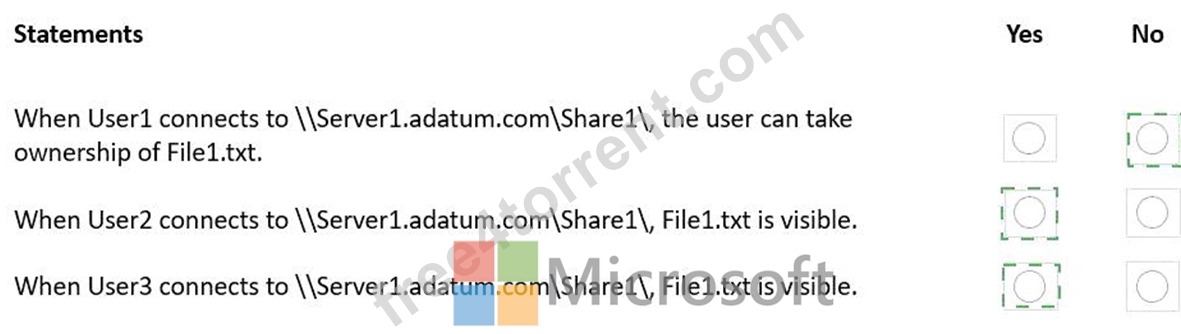
Explanation
Graphical user interface, text, application, email Description automatically generated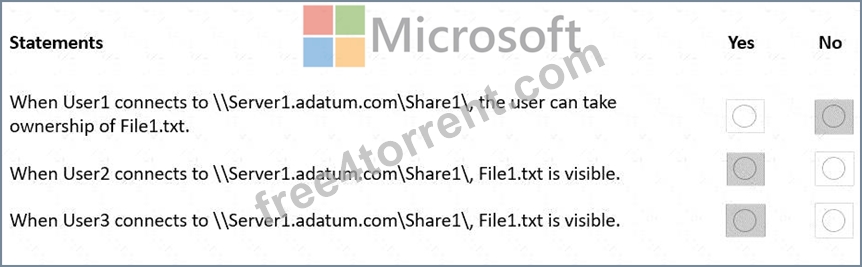
NEW QUESTION # 108
Case Study 2 - Contoso, Ltd
Overview
Contoso, Ltd. is a company that has a main office in Seattle and two branch offices in Los Angeles and Montreal.
Existing Environment
AD DS Environment
The network contains an on premises Active Directory Domain Services (AD DS) forest named contoso.com. The forest contains two domains named contoso.com and canada.contoso.com.
The forest contains the domain controllers shown in the following table.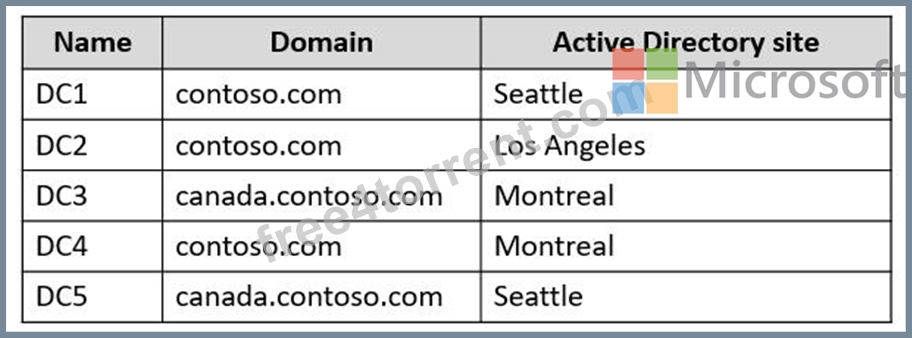
All the domain controllers are global catalog servers.
Server infrastructure
The network contains the servers shown in the following table.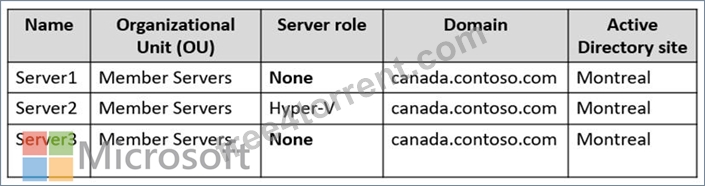
A server named Server4 runs Windows Server and is in a workgroup. Windows Firewall on Server4 uses the private profile.
Server2 hosts three virtual machines named VM1, VM2, and VM3.
VM3 is a file server that stores data in the volumes shown in the following table.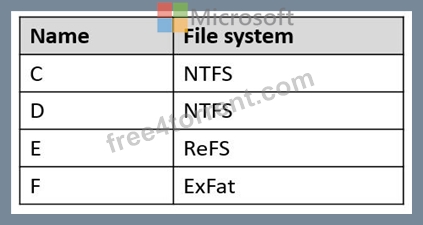
Group Policies
The contoso.com domain has the Group Policies Objects (GPOs) shown in the following table.
Existing Identities
The forest contains the users shown in the following table.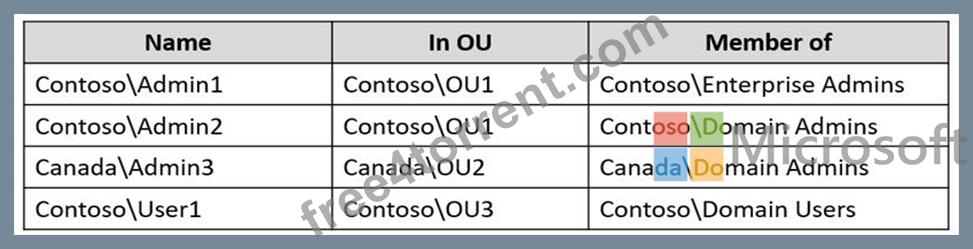
The forest contains the groups shown in the following table.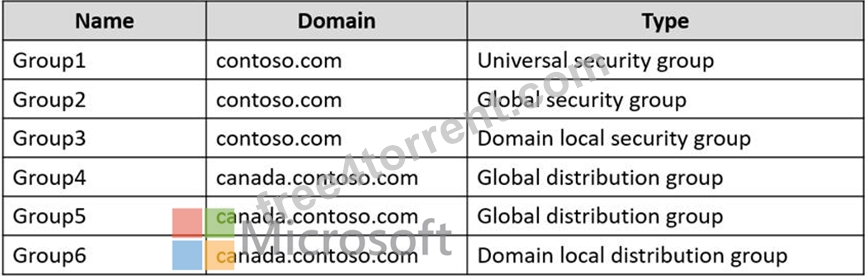
Current Problems
When an administrator signs in to the console of VM2 by using Virtual Machine Connection, and then disconnects from the session without signing out, another administrator can connect to the console session as the currently signed in user.
Requirements
Technical Requirements
Contoso identifies the following technical requirements:
Change the replication schedule for all site links to 30 minutes.
Promote Server1 to a domain controller in canada.contoso.com.
Install and authorize Server3 as a DHCP server.
Ensure that User1 can manage the membership of all the groups in Contoso\OU3.
Ensure that you can manage Server4 from Server1 by using PowerShell remoting.
Ensure that you can run virtual machines on VM1.
Force users to provide credentials when they connect to VM2.
On VM3, ensure that Data Deduplication on all volumes is possible.
Question
You need to meet the technical requirements for VM2.
What should you do?
- A. Enable enhanced session mode.
- B. Implement Credential Guard.
- C. Enable the Guest services integration service.
- D. Implement shielded virtual machines.
Answer: A
Explanation:
Prevent a VMConnect user from taking over another user's VMConnect session Turn on enhanced session mode on Hyper-V host.
Not having enhanced session mode turned on may pose a security and privacy risk. If a user is connected and logged on to a virtual machine through VMConnect and another authorized user connects to the same virtual machine, the session will be taken over by the second user and the first user will lose the session. The second user will be able to view the first user's desktop, documents, and applications.
https://learn.microsoft.com/en-us/windows-server/virtualization/hyper-v/learn-more/hyper-v- virtual-machine-connect
NEW QUESTION # 109
Your network contains an Active Directory domain, a web app named App1, and a perimeter network. The perimeter network contains a server named Server1 that runs Windows Server.
You plan to provide external access to App1.
You need to implement the Web Application Proxy role service on Server1.
Which role should you add to Server1, and which role should you add to the network? To answer, drag the appropriate roles to the correct targets. Each role may be used once, more than once, or not at all. You may need to drag the split bar between panes or scroll to view content.
Answer:
Explanation:
Explanation:
NEW QUESTION # 110
Your network contains an Active Directory Domain Services (AD DS) domain named adatum.com.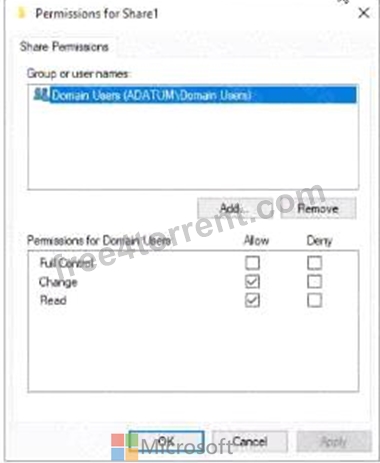
The domain contains a 'He server named Server1 and three users named User1. User2 and User), Server1 contains a shared folder named Share1 tha1 has the following configurations: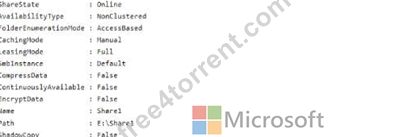
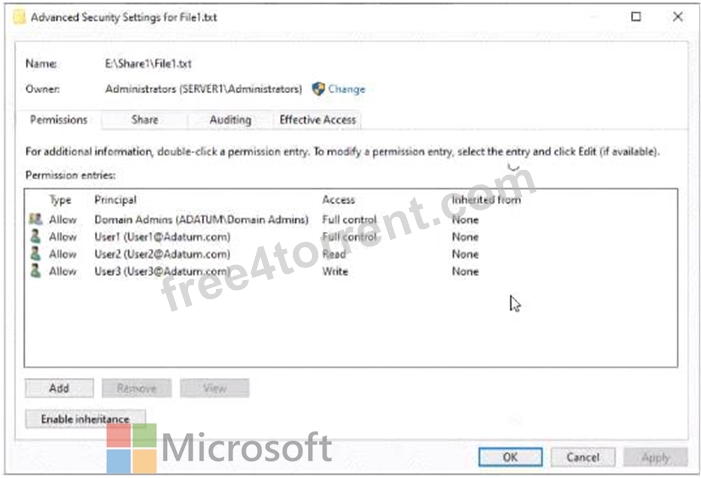
The share permissions for Share1 are configured as shown in the Share Permissions exhibit. (Click the Share Permissions tab.) Share! contains a file named Filel.txt. The advanced security settings for Filel.txt are configured as shown in the File Permissions exhibit. (Click the File Permissions tab.) For each of the following statements, select Yes if the statement is true. Otherwise, select No.
NOTE: f ach correct selection is worth one point.
Answer:
Explanation:
Explanation
NEW QUESTION # 111
You have an onpremises DNS server named Server1 that runs Windows Server. Server 1 hosts a DNS zone named fabrikam.com You have an Azure subscription that contains the resources shown in the following table.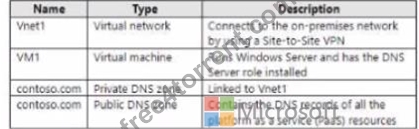
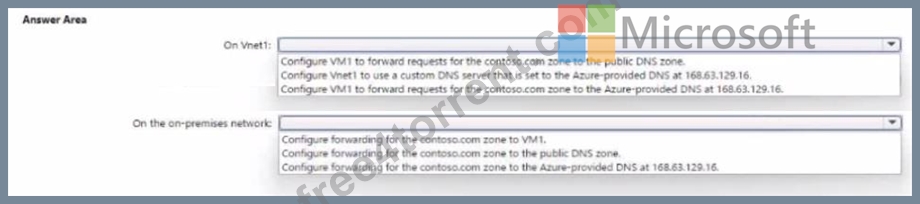
Answer:
Explanation: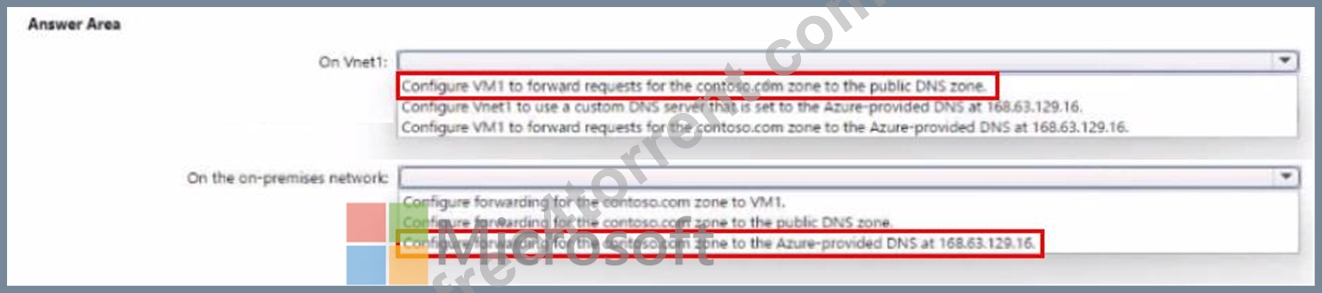
NEW QUESTION # 112
You need to implement a name resolution solution that meets the networking requirements. Which two actions should you perform? Each correct answer presents part of the solution.
NOTE: Each correct selection is worth one point
- A. Configure a conditional forwarder on DC3.
- B. Create an Azure DNS zone named corp.fabrikam.com.
- C. Create a virtual network link in the coip.fabnkam.c om Azure private DNS zone.
- D. Enable autoregistration in the corp.fabnkam.com Azure private DNS zone.
- E. Configure the DNS Servers settings for Vnet1.
- F. Create an Azure private DNS zone named corp.fabhkam.com.
- G. On DC3, install the DNS Server role.
Answer: E,G
Explanation:
Explanation
Virtual machines in an Azure virtual network receive their DNS configuration from the DNS settings configured on the virtual network. You need to configure the Azure virtual network to use DC3 as the DNS server. Then all virtual machines in the virtual network will use DC3 and their DNS server.
NEW QUESTION # 113
You have an onpremises DNS server named Server1 that runs Windows Server. Server 1 hosts a DNS zone named fabrikam.com You have an Azure subscription that contains the resources shown in the following table.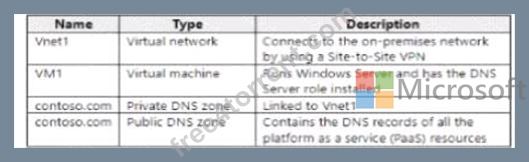
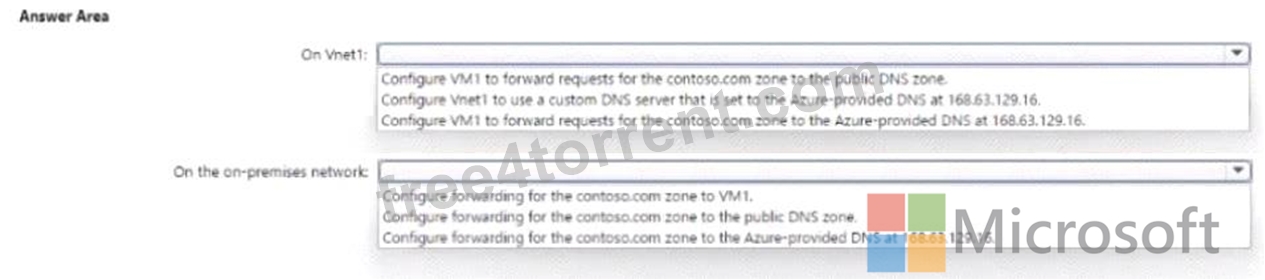
Answer:
Explanation: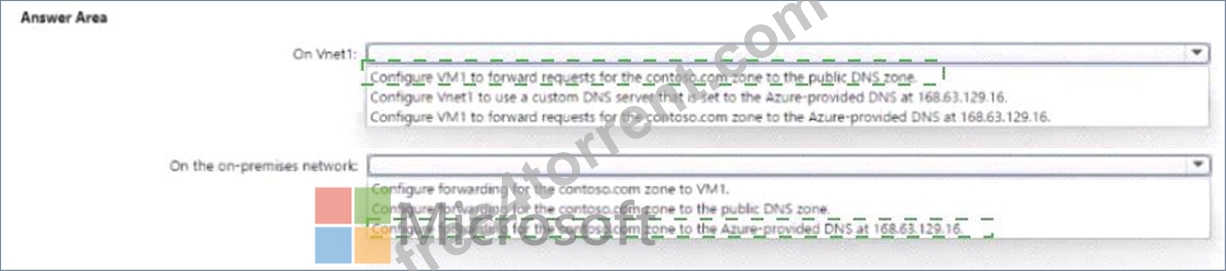
Explanation
NEW QUESTION # 114
You have a server that runs Windows Server and contains a shared folder named UserData.
You need to limit the amount of storage space that each user can consume in UserData.
What should you use?
- A. Distributed File System (DFS) Namespaces
- B. Work Folders
- C. File Server Resource Manager (FSRM)
- D. Storage Spaces
Answer: C
Explanation:
Reference:
https://docs.microsoft.com/en-us/windows-server/storage/fsrm/fsrm-overview
NEW QUESTION # 115
You have on-premises file servers that run Windows Server as shown in the following table.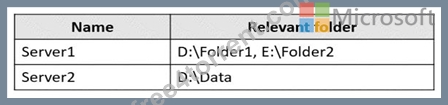
You have the Azure file shares shown in the following table.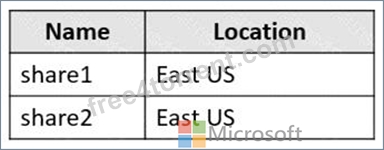
You add a Storage Sync Service named Sync1 and an Azure File Sync sync group named Group1. Group1 uses share1 as a cloud endpoint.
You register Server1 and Server2 with Sync1. You add D:\Folder1 from Server1 as a server endpoint in Group1.
For each of the following statements, select Yes if the statement is true. Otherwise, select No.
NOTE: Each correct selection is worth one point.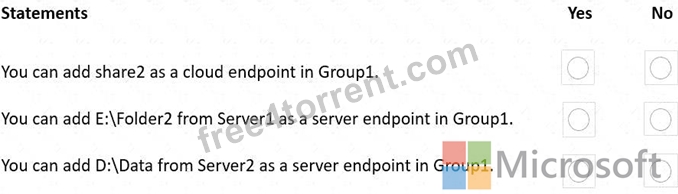
Answer:
Explanation: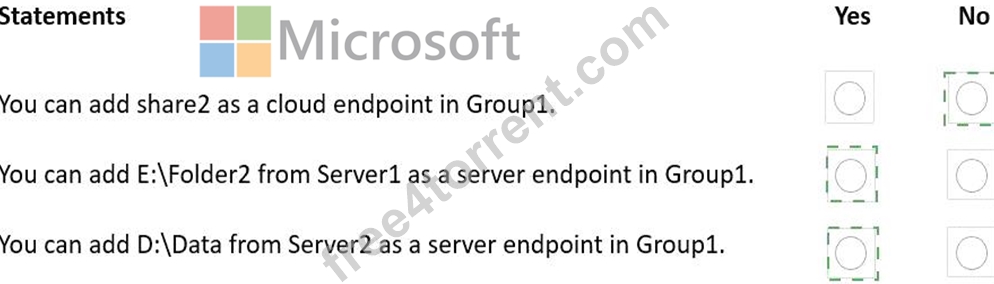
Explanation
Graphical user interface, text, application, email Description automatically generated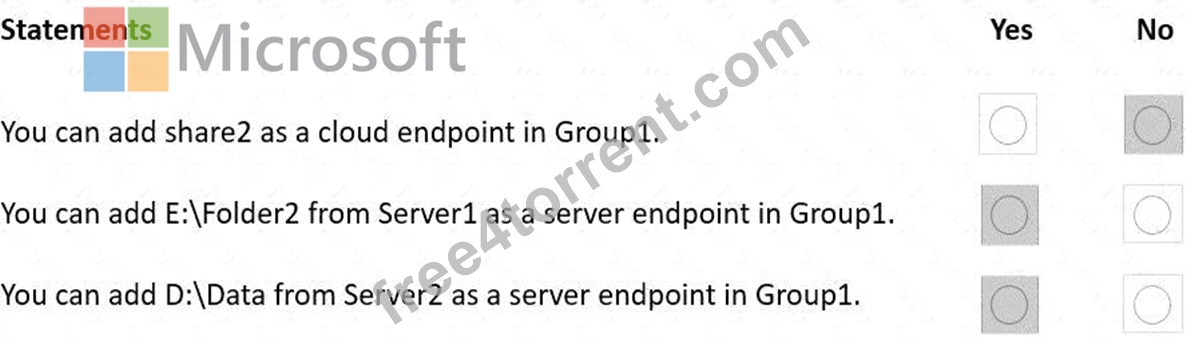
Reference:
https://docs.microsoft.com/en-us/azure/storage/file-sync/file-sync-planning
NEW QUESTION # 116
Case Study 2 - Contoso, Ltd
Overview
Contoso, Ltd. is a company that has a main office in Seattle and two branch offices in Los Angeles and Montreal.
Existing Environment
AD DS Environment
The network contains an on premises Active Directory Domain Services (AD DS) forest named contoso.com. The forest contains two domains named contoso.com and canada.contoso.com.
The forest contains the domain controllers shown in the following table.
All the domain controllers are global catalog servers.
Server infrastructure
The network contains the servers shown in the following table.
A server named Server4 runs Windows Server and is in a workgroup. Windows Firewall on Server4 uses the private profile.
Server2 hosts three virtual machines named VM1, VM2, and VM3.
VM3 is a file server that stores data in the volumes shown in the following table.
Group Policies
The contoso.com domain has the Group Policies Objects (GPOs) shown in the following table.
Existing Identities
The forest contains the users shown in the following table.
The forest contains the groups shown in the following table.
Current Problems
When an administrator signs in to the console of VM2 by using Virtual Machine Connection, and then disconnects from the session without signing out, another administrator can connect to the console session as the currently signed in user.
Requirements
Technical Requirements
Contoso identifies the following technical requirements:
Change the replication schedule for all site links to 30 minutes.
Promote Server1 to a domain controller in canada.contoso.com.
Install and authorize Server3 as a DHCP server.
Ensure that User1 can manage the membership of all the groups in Contoso\OU3.
Ensure that you can manage Server4 from Server1 by using PowerShell remoting.
Ensure that you can run virtual machines on VM1.
Force users to provide credentials when they connect to VM2.
On VM3, ensure that Data Deduplication on all volumes is possible.
Question
You need to meet the technical requirements for Server1.
Which users can currently perform the required tasks?
- A. Admin3 only
- B. Admin1 and Admin3 only
- C. Admin1, Admin2 and Admin3
- D. Admin1 only
Answer: B
NEW QUESTION # 117
You have on-premises servers that run Windows Server as shown in the following table.
You have an Azure file share named share1 that stores two files named File2.docx and File3.docx.
You create an Azure File Sync sync group that includes the following endpoints:
share
D:\Folder1 on Server1
D:\Datal on Server2
For each of the following statements, select Yes if the statement is true. Otherwise, select No.
NOTE: Each correct selection is worth one point.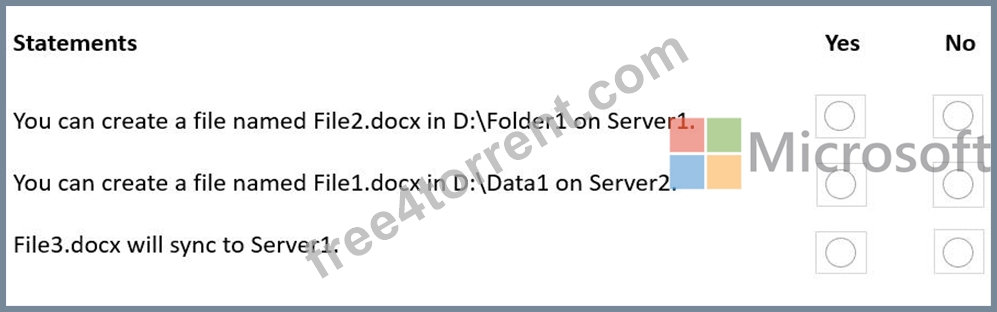
Answer:
Explanation: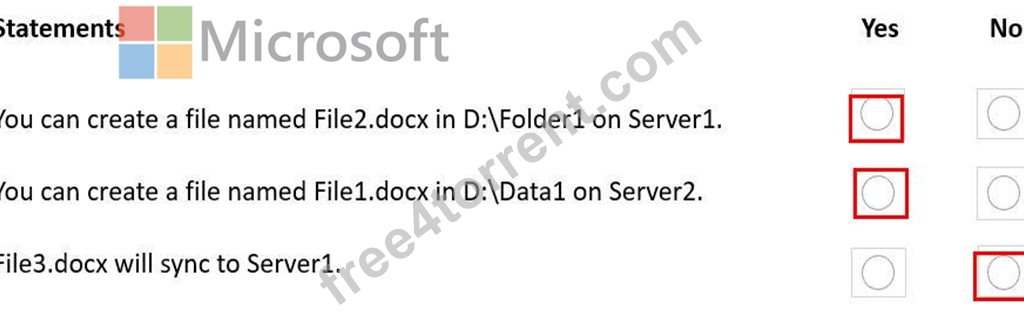
Reference:
https://docs.microsoft.com/en-us/azure/storage/file-sync/file-sync-introduction
NEW QUESTION # 118
Your network contains an Active Directory Domain Services (AD DS) domain named contoso.com. The domain contains two servers named Server1 and Server2.
Server1 contains a disk named Disk2. Disk2 contains a folder named UserDat a. UserData is shared to the Domain Users group. Disk2 is configured for deduplication. Server1 is protected by using Azure Backup.
Server1 fails.
You connect Disk2 to Server2.
You need to ensure that you can access all the files on Disk2 as quickly as possible.
What should you do?
- A. Install the Data Deduplication server role.
- B. Install the File Server Resource Manager server role.
- C. Create a storage pool.
- D. Restore files from Azure Backup.
Answer: B
Explanation:
Reference:
https://docs.microsoft.com/en-us/windows-server/storage/data-deduplication/overview
NEW QUESTION # 119
......
Maximum Grades By Making ready With AZ-800 Dumps: https://pdfdumps.free4torrent.com/AZ-800-valid-dumps-torrent.html